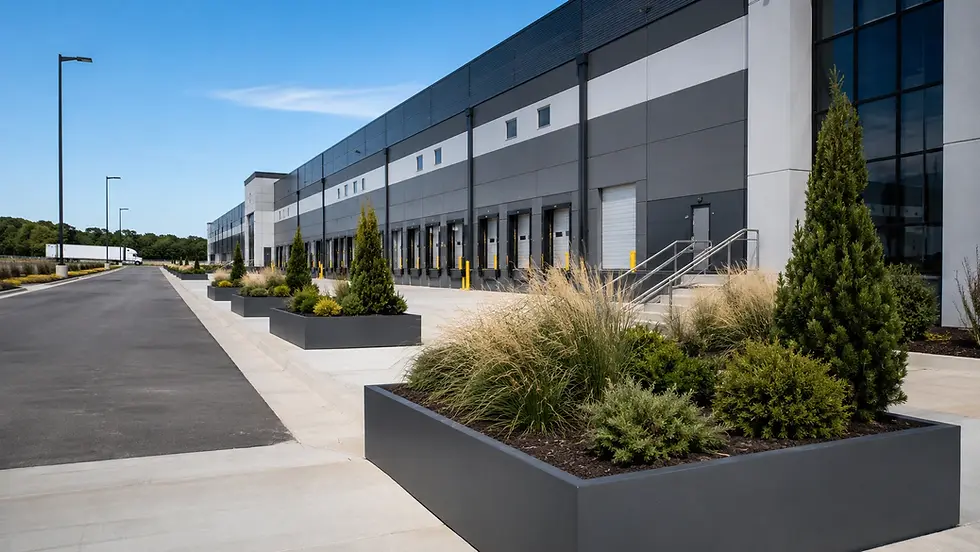
Commercial Planter Materials: A Technical Guide for Sustainable Urban Infrastructure
Updated: Feb 16
Updated : February 16th, 2026
The Shift Toward High-Performance Urban Greenery
In cities such as Toronto, New York, and Chicago, sustainability is now a baseline requirement for both structural integrity and long-term value. Selecting an inappropriate material for a rooftop or high-traffic public space can result in premature structural issues, increased maintenance, and unnecessary replacement.
This guide examines the lifecycle, structural performance, and environmental impact of the primary materials used in commercial-grade planters, with a focus on aligning engineering standards with architectural requirements.
Key Takeaway:
For high-performance urban landscaping, material selection is a structural requirement, not just an aesthetic choice. 5052-H32 Marine-Grade Aluminum is the industry benchmark for rooftops, offering a 75% weight reduction over concrete and total corrosion resistance. To ensure long-term ROI in extreme climates (Toronto/NYC/Montreal), specifications must include high R-value thermal insulation, modular systems like Edges, and mechanical anchoring for high-velocity wind zones.

1. 5052-H32 Marine-Grade Aluminum: The Sustainable Benchmark
For high-exposure environments—such as coastal balconies or skyscraper rooftops—5052-H32 marine-grade aluminum is the gold standard.
Why it’s the Professional Choice:
Structural Efficiency: Aluminum is approximately 75% lighter than traditional cast concrete. This allows architects to maximize greenery on weight-sensitive slabs without costly structural reinforcement.
Infinite Recyclability: Aluminum can be recycled indefinitely without losing its structural properties. At the end of its 25+ year lifecycle, an Urban Pot aluminum planter remains a valuable resource, not landfill waste.
Corrosion Resistance: Unlike standard steel, the 5052-H32 alloy is specifically engineered to resist salt spray and urban pollutants, ensuring the finish remains pristine for decades.
Sustainability ROI: Reduced shipping emissions (due to low weight) and zero replacement frequency over 20+ years.
2. Weathering Steel (Corten): Natural Longevity
Corten Steel provides a weathered, industrial appearance and is valued for its long-term durability in exposed environments.
Engineering Considerations:
Self-Protecting Patina: Corten develops a stable, rust-like oxidation layer that acts as a protective coating, eliminating the need for volatile organic compound (VOC)-heavy paints.
Urban Pot Advantage: To prevent the common issue of rust runoff staining expensive pavers, we offer pre-oxidation services and specialized drainage stand-offs (6mm clearance) to protect the surrounding site architecture.

3. High-Density GFRC and Professional Composites
When a monolithic, stone-like appearance is required, Glass Fiber-Reinforced Concrete (GFRC) and commercial-grade fiberglass provide the desired aesthetic while significantly reducing weight compared to solid masonry.
Performance in Extreme Climates:
Freeze-Thaw Resilience: Our GFRC and professional fiberglass composites are engineered to withstand expansion and contraction. Unlike cheap resin pots, they will not crack during the brutal -30°C to +35°C temperature swings typical of the Canadian climate.
Thermal Protection: These materials offer natural R-value insulation, protecting sensitive root balls from thermal shock—a critical factor for the survival of perennials and trees in high-altitude planters.
Beyond the Material: The Engineering of Sustainability
A. Modular "Edges" Systems for Continuous Landscapes
Sustainable design also requires adaptability. Modular systems can be configured without planter bottoms and integrated with the building’s drainage membrane. This approach reduces material use and supports a more natural plant ecosystem.
B. Maintenance Reduction and Water Conservation
Sustainable planters are designed to conserve resources throughout their operational life. Key engineering considerations include:
Integrated Sub-Irrigation: Reducing water consumption by up to 50%.
Strategic Drainage: Surmounted lateral drainage holes prevent root rot while maintaining a small, essential water reservoir for drought resistance.
Material Performance Matrix: North American Standards
Material | Structural Load | Corrosion Resistance | Lifecycle | Recyclability |
5052-H32 Aluminum | Ultra-Light | Extreme (Marine Grade) | 25+ Years | 100% |
Corten Steel | Heavy | High (Self-Patina) | 25+ Years | 100% |
Commercial Fiberglass | Light | High (UV Rated) | 15-20 Years | Low |
GFRC Concrete | Medium/Heavy | High | 20+ Years | Moderate |
Case Study: High-Altitude Resilience in Toronto’s Core
A recent downtown Toronto rooftop project required solutions for high wind uplift and strict slab weight limits. By specifying 5052-H32 aluminum systems with integrated internal ballast brackets, the installation maintained stability in 100 km/h winds and reduced weight by 75% compared to masonry alternatives.
Conclusion: Partnering with Urban Pot
Selecting the appropriate material requires balancing structural demands, climate conditions, and environmental responsibility. Technical expertise at the specification stage ensures the resulting installation is both durable and aligned with the project’s long-term goals.
Frequently Asked Questions (FAQ)
1. Why is 5052-H32 aluminum preferred over standard steel for rooftop projects?
Weight and corrosion resistance are the main factors. Standard steel is heavier and rusts if its coating is compromised. Our marine-grade 5052-H32 aluminum is 75% lighter than concrete and naturally forms a protective oxide layer, making it resistant to salt and pollutants in high-density urban areas like Toronto or Montreal.
2. How do Urban Pot planters withstand extreme Canadian winters?
Standard planters often crack during freeze-thaw cycles because they lack the flexibility to handle soil expansion. We engineer our commercial-grade planters with internal reinforcements and offer optional R-value thermal insulation. This protects the planter’s integrity and shields root balls from thermal shock, ensuring your landscape survives until spring.
3. Can I order custom sizes to fit a specific architectural layout?
Absolutely. While we offer a wide range of standard collections, our specialty is the Custom Studio. We work from your CAD or Revit files to manufacture planters with millimetric precision, including complex geometries and our signature Edges modular systems for continuous landscape ribbons.
4. What is the best way to anchor planters in high-velocity wind zones?
Safety is paramount for high-rise terraces. Our technical team provides pre-drilled anchoring points for mechanical fastening directly into the slab. For projects where the roof membrane cannot be pierced, we design planters with internal ballast compartments or integrated "tie-down" brackets to ensure stability against "lake effect" winds and high-altitude gusts.
5. How do Urban Pot solutions contribute to LEED certification?
Our products support green building initiatives in several ways. We prioritize sustainable materials, such as 100% recyclable aluminum and Corten steel. Additionally, by reducing replacement frequency (25+-year lifecycle) and offering integrated water-saving sub-irrigation systems, we help projects meet strict environmental and resource-efficiency standards.