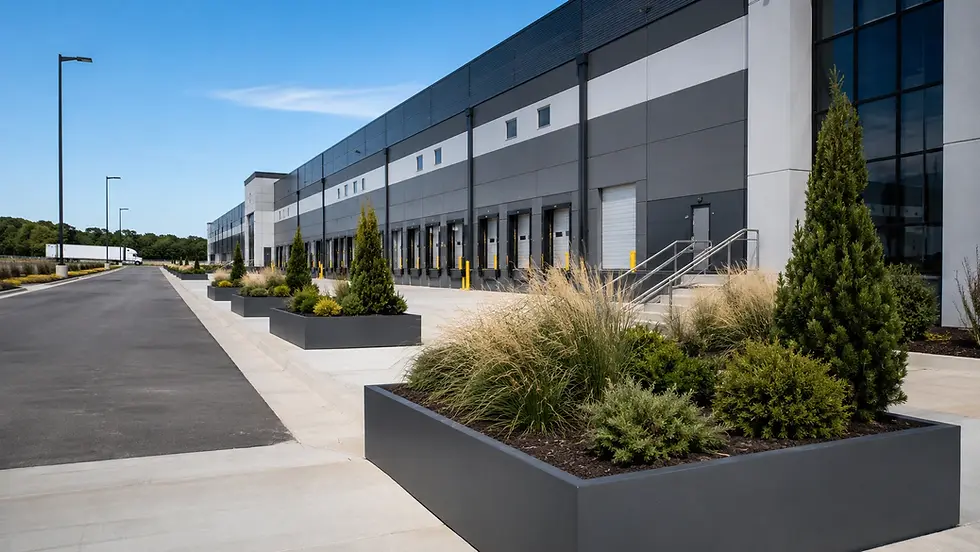
Rooftop Planters: A Commercial Selection and Specification Guide
- Dec 16, 2024
- 9 min read
Updated: Aug 25
A rooftop planter is a freestanding or modular container designed for planting on an elevated roof terrace, podium, balcony, or amenity deck. Unlike a ground-level container, it must be coordinated with structural load capacity, saturated growing-medium weight, wind pressure, drainage, waterproofing, irrigation, and restricted delivery access.
Urban Pot designs standard and custom rooftop planters for architects, landscape architects, contractors, and developers across Canada and the United States. From Montreal and Toronto to New York and Seattle, project teams use lightweight rooftop planters to add planting volume, privacy, circulation control, and architectural continuity without defaulting to heavy built-in masonry.
This guide explains the decisions that should be resolved before a rooftop planter reaches the drawings, quotation, or fabrication stage.

What Makes Rooftop Planters Different From Ordinary Outdoor Planters?
Rooftop planters are different because every component affects the building as well as the planting. A planter at grade can often drain into adjacent soil and can be moved with standard equipment. A rooftop unit sits above a roof assembly, faces stronger wind exposure, and may need to pass through elevators, doors, or limited crane zones.
The design team should treat the planter as a coordinated site element. Its shell, growing medium, water, vegetation, insulation, drainage components, ballast, and anchors all affect total load. Its base and outlets affect the waterproofing membrane. Its location can also affect egress, access to roof drains, and future maintenance. Urban Pot provides related guidance for commercial planters and ongoing operation and maintenance planning.
Start With the Complete Rooftop Planter Load
Calculate the planter at its heaviest credible condition, not at its empty shipping weight. Include the shell, saturated growing medium, plants at maturity, retained water, irrigation components, snow or ice, and any ballast or anchoring hardware.
The structural engineer should confirm both the overall load and the local point or line loads at each support. ASCE 7-22 covers dead, live, soil, snow, rain, ice, seismic, and wind loads in the United States. Canadian projects should use the locally adopted code edition, with the National Building Code of Canada 2025 as the national model reference.
As context, the U.S. General Services Administration notes that extensive planted-roof assemblies often add about 15 to 30 pounds per square foot, depending on the growing medium and other layers. A freestanding planter can impose a much higher local load because the soil is concentrated in a smaller footprint. Request the actual saturated medium density and finished planter weight instead of copying a generic value from another project.
Reduce load without reducing visible height
A false bottom or internal shelf can preserve a tall architectural profile while limiting active soil depth. This can reduce growing-medium volume, retained water, installation labor, and total saturated weight. The remaining planting depth must still meet the landscape architect’s requirements, and a false bottom should not be counted as wind ballast unless it was designed for that purpose. See Urban Pot’s lightweight rooftop planter guide for additional load-planning questions.
Compare Rooftop Planter Materials Using Project Data
No single material is correct for every roof. Compare empty weight, reinforcement, corrosion resistance, thermal behavior, fire documentation, finish performance, fabrication limits, and the required delivery method.
Material | Verified or requested spec | Relative shell weight | Main rooftop advantage | Key project check |
5052-H32 aluminum | Urban Pot standard: 1/8 in, or 3.2 mm; reinforcement by size | Low; density about 2.68 g/cm3 | Custom shapes, corrosion resistance, low dead load | Coating standard, stiffeners, dark-finish insulation, weld details |
Fiberglass or FRP | Request laminate schedule, empty weight, resin, UV and fire documentation | Low | Light handling weight and lower thermal conductivity | Impact resistance, repair method, warranty, exact fire test |
Corten steel | Project-specific gauge and reinforcement | High; steel density about 7.85 g/cm3 | Non-combustible shell and architectural patina | Oxide runoff, deck staining, drainage gap, slab capacity |
Concrete or GFRC | Request unit weight, wall section, lifting points, and support layout | High to medium | Stability and non-combustible construction | Crane access, concentrated load, membrane protection, replacement access |
Table note: Final wall thickness, reinforcement, empty weight, and finish requirements depend on planter dimensions, soil pressure, anchoring, exposure, and fabrication method. Urban Pot lists 1/8-inch 5052 aluminum for its standard metal planters. Hydro describes 5052 as a higher-strength, non-heat-treatable magnesium alloy, and FGIA identifies AAMA 2604-26 as the current high-performance organic-coating specification for architectural aluminum.
Related technical guides: Rooftop Planters for High Wind | Lightweight Rooftop Planters for Load Restrictions | Fire-Resistant Commercial Planters for Rooftops
For low-weight commercial applications, compare Urban Pot’s metal planters and fiberglass planters. For aluminum exposed to demanding exterior conditions, specify the required coating class rather than using the vague phrase “exterior-grade finish.” The current AAMA 2604-26 specification covers high-performance organic coatings on architectural aluminum extrusions and panels.

Size the Planter Around Plants, Loads, and Access
Planter dimensions should be established from the inside out. Begin with the root-ball size, mature plant form, required soil volume, irrigation method, and drainage zone. Then add insulation, liners, false bottoms, structural reinforcement, and the exterior finish.
Many shrub specifications begin around 18 to 24 inches of active growing depth, while small trees usually need more. These are preliminary planning ranges, not universal rules. The landscape architect should confirm species-specific depth and volume, and the structural engineer should evaluate the resulting saturated load. Urban Pot’s rooftop planter soil guide can support the planting discussion, but the project soil supplier should provide the final saturated density.
Before approving a large unit, verify freight-elevator dimensions, door clearances, turning radii, roof hatches, crane reach, allowable pick weight, and permitted delivery hours. Split or modular fabrication may be more practical than one oversized planter, especially on existing buildings.
Design Drainage and Protect the Roof Membrane
Rooftop planters need a documented drainage path and an overflow strategy. Water must leave the growing medium without ponding inside the planter, blocking a roof drain, staining the deck, or damaging the waterproofing system.
A typical commercial detail may include engineered growing medium, filter fabric, a drainage board or cell, a root barrier where required, elevated side or bottom outlets, and a protected air gap beneath the planter. Coordinate outlet size and location with the plumbing and roofing teams. Keep roof drains and inspection zones accessible after planting.
Do not add a rock or gravel layer as a universal drainage fix. Penn State Extension identifies coarse material at the bottom of a container as counterproductive because it can worsen drainage. Use a designed drainage layer and appropriate growing medium instead. For storage and controlled-release concepts, review Urban Pot’s stormwater-smart rooftop planter guide and bioretention planter article.
If the planter includes a sub-irrigation reservoir, specify reservoir capacity, overflow elevation, inspection access, winterization, and the separation between stored water and the structural shell.
Engineer Rooftop Planters for Wind, Not Just Weight
A heavy planter is not automatically wind-safe. Wind can cause sliding, overturning, uplift, soil loss, and large forces from a mature tree or shrub canopy. Exposure is often greatest near roof corners, edges, gaps between buildings, and elevated terraces above surrounding structures.
The project engineer should evaluate the planter geometry, center of gravity, plant canopy, building height, local wind criteria, and the capacity of the roof structure. Solutions may include integrated ballast zones, concealed mechanical anchors, linked modules, non-penetrating frames, or a lower planting profile. Any penetration must be coordinated with the waterproofing manufacturer and roof warranty. Urban Pot’s wind-resistance and anchoring guide explains the coordination questions in more detail.
Plan for Canadian Freeze-Thaw Cycles and Summer Heat
Rooftop exposure can combine freezing temperatures, solar heat, wind, snow accumulation, and rapid temperature changes. The specification should address both the planter shell and the root zone.
In Montreal and other Quebec markets, water must be able to leave the planter before freezing conditions create expansion pressure. Dark metal finishes can also raise soil temperatures during summer sun, so interior insulation may be needed even when winter protection is the first concern. Specify a non-porous or documented freeze-thaw-resistant shell, drainage that remains serviceable, and insulation suited to the planting and exposure.
Urban Pot provides material data, planter dimensions, drainage options, and project-specific specification information on request. Contact the team at team@urbanpot.com for technical documentation.
Use Rooftop Planters as Functional Architectural Elements
Commercial rooftop planters can define dining areas, separate circulation from seating, create privacy, screen mechanical equipment, frame views, and integrate branding or lighting. Long troughs can establish clear edges, while modular groups can adapt around roof drains, columns, access hatches, and furniture layouts.
Planter placement must preserve required egress widths, guard conditions, maintenance paths, and access to building systems. For projects that combine screening and planting, explore Urban Pot’s privacy planters, custom planter capabilities, and North American project portfolio.

Coordinate Shop Drawings, Fabrication, and Delivery Early
A complete rooftop planter request for quotation should include project location, quantity, exterior dimensions, active soil depth, material, finish, drain type and outlet location, insulation, false bottoms, anchoring interfaces, modular joints, delivery constraints, and the required submittals.
Request shop drawings that show the planter section, reinforcement, base support, drainage outlets, lifting or handling points, and connection details. Also request the empty unit weight and the information needed to calculate saturated operating weight. Confirm the production schedule after drawing approval, because revisions to dimensions, finishes, or drainage can reset fabrication timing. Urban Pot’s commercial planter specification guide provides a broader RFQ framework.
Rooftop Planter Specification Checklist
1. Confirm the locally adopted building code and the structural load allowance for each planter location.
2. Calculate the shell, saturated medium, plants, water, snow or ice, irrigation components, and ballast.
3. Confirm plant-specific soil depth and usable internal volume with the landscape architect.
4. Select the planter material using actual unit weight, reinforcement, corrosion, thermal, and fire data.
5. Specify drainage outlets, overflow, filter layers, root protection, and roof-drain access.
6. Coordinate the planter base with the waterproofing membrane and roofing warranty.
7. Determine wind resistance through ballast, anchors, linked modules, or another engineered method.
8. Define insulation and finish performance for freeze-thaw exposure and summer heat.
9. Protect egress, guard conditions, maintenance routes, and access to roof equipment.
10. Verify elevator, door, hatch, crane, and installation-hour limits before approving unit size.
11. Request shop drawings, finish samples, empty weights, and project-specific technical data.
12. Update the specification after submittal review and before fabrication release.
Frequently Asked Questions About Rooftop Planters
What is the best material for commercial rooftop planters?
Aluminum and fiberglass are common choices because they reduce shell weight while supporting large formats. Aluminum offers structural rigidity and custom fabrication. Fiberglass offers low handling weight and lower thermal conductivity. The final choice should reflect structural capacity, wind, fire documentation, finish, climate, and maintenance requirements.
For reference, empty-shell weight for aluminum planters runs dramatically lighter than concrete units of a comparable size, often by a factor of four or more, the gap that drives most rooftop material decisions before soil or plants are even factored in. Fire documentation also becomes a deciding factor on high-rise projects subject to NFPA 285 or local fire code review for combustible planting materials near building envelopes.
How do you calculate the weight of a rooftop planter?
Add the empty planter, saturated growing medium, mature plants, retained water, drainage and irrigation components, snow or ice, and ballast or anchors. The structural engineer should review both total load and local point or line loads at the planter supports.
As a working reference, saturated growing medium commonly weighs 50-60 lbs per cubic foot depending on mix composition, versus 20-30 lbs per cubic foot dry, which is why 'empty weight' figures from a manufacturer's spec sheet consistently understate real in-service load by roughly 2x. Snow load should use the project's ground snow load value from the local building code, not a flat assumption, since rooftop drift patterns near parapets or mechanical equipment can locally exceed the base design value.
Do rooftop planters need drainage?
Yes. Rooftop planters need a designed outlet and overflow path so water does not saturate the root zone, increase load, block roof drains, stain finishes, or damage waterproofing. Coordinate drainage with the roofing, plumbing, landscape, and planter teams.
A functioning drainage layer typically reduces retained water weight compared to a saturated planter with no engineered drainage path, though the effect varies meaningfully by growing medium (organic, loamless mixes see the biggest reduction; loam-based mixes see less), a meaningful factor in the total load calculation, not just a maintenance detail. Outlet sizing should also account for peak rainfall intensity for the project's region, not just average annual rainfall, since undersized outlets are a common cause of temporary ponding during heavy storm events.
How are rooftop planters secured against wind?
Rooftop planters may use integrated ballast, concealed mechanical anchors, linked modules, or non-penetrating support frames. The correct method depends on planter geometry, building height, roof location, plant canopy, local wind criteria, and structural capacity.
ASCE 7-22 wind load calculations for rooftop elements typically require checking both component-and-cladding pressures at roof edges/corners (where uplift coefficients are highest) and overall structure pressures; a planter engineered only against the second can still fail at a parapet-adjacent location. Anchoring solutions should be tested against the fully-grown plant canopy's wind-catching surface area, not the planter's empty silhouette, since mature planting can significantly increase effective sail area as the canopy fills in over time.
Are rooftop planters the same as a green roof?
No. Rooftop planters are discrete containers placed on a roof or terrace. A green roof is a layered vegetated roof assembly. They share structural, drainage, and planting concerns, but their load distribution, waterproofing interfaces, maintenance access, and environmental performance are not identical.
The practical distinction matters for code review: green roofs are typically reviewed under vegetative roof provisions in the building code (addressing continuous waterproofing membrane performance across the full roof area), while discrete rooftop planters are usually reviewed as point loads or line loads on an otherwise conventional roof assembly.
Projects combining both, planters placed on top of an existing green roof or podium deck, should confirm which review pathway the local authority having jurisdiction (AHJ) applies, since requirements can differ.
Specify Rooftop Planters for Canadian Commercial Projects
Successful rooftop planter installations depend on coordinated decisions, not appearance alone. Structural load, saturated growing medium, material performance, drainage, wind, insulation, planting volume, waterproofing, access, and delivery should be resolved before fabrication.
Urban Pot works with architects, landscape architects, contractors, and developers across Canada and the United States. Explore metal rooftop planter options and fiberglass planter options.