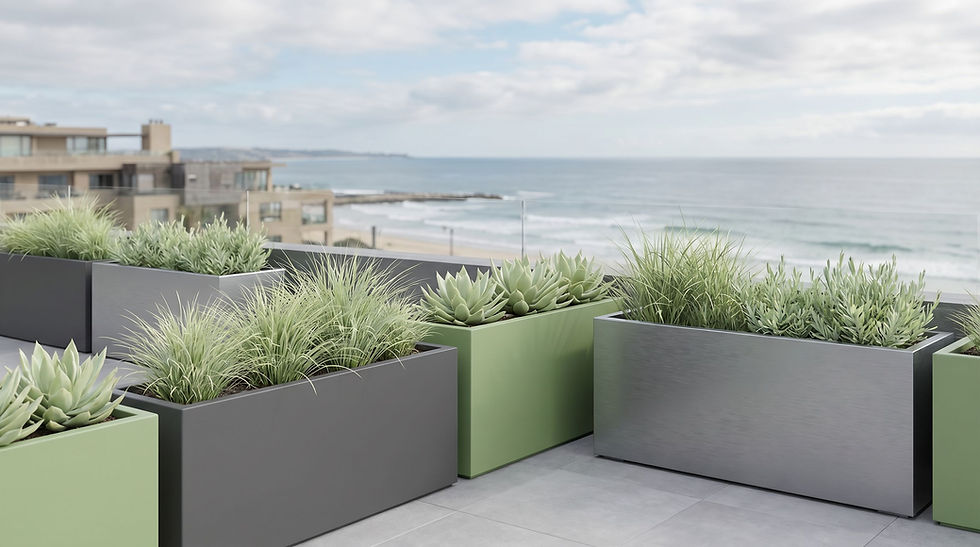
Modular Rooftop Planters: How to Build Lightweight, Nature-Rich Rooftop Landscapes
Updated: May 20
Rooftop terraces have become some of the most coveted amenity spaces in North American commercial and high-end residential projects. From Manhattan parapet gardens to Toronto podium decks, landscape architects and contractors are being asked to deliver immersive, plant-rich environments on surfaces that were never originally intended to support a forest. The challenge is rarely creative; it's structural, logistical, and material.
Building a nature-drenched rooftop oasis with modular, lightweight containers is the most reliable way to reconcile those competing demands. Done correctly, a modular planter strategy lets you distribute load intelligently, adapt to irregular geometries, and refresh the design over time without tearing up the membrane. This guide walks through the technical decisions that separate a thriving rooftop landscape from an expensive liability.
Quick Rooftop Planter Specs
Element | Recommendation |
Soil depth | 18–24” for shrubs, deeper for trees |
Preferred materials | Marine-grade aluminum, fiberglass |
Drainage | Elevated side-wall outlets |
Wind strategy | Ballast, anchoring, linked modules |
Irrigation | Subsurface drip systems |
Freeze-thaw | Non-porous materials only |

Start with structural load and wind analysis
Before any planter is specified, the project team needs a clear picture of what the roof can carry. Saturated soil is dramatically heavier than dry mix, so calculations should always be done at field capacity. Engineered lightweight rooftop media is typically specified instead of standard topsoil.
Specifiers typically address this by combining lightweight engineered soils with strategic use of drainage fill, and by concentrating heavier planters directly over columns or load-bearing walls.
Wind uplift is the second invisible force at play. On exposed high-rise decks, modular planters can be ballasted, mechanically linked, or anchored to non-penetrating ballast curbs to resist gusts without compromising the waterproofing membrane.
Why modular, lightweight containers outperform monolithic builds
Modular systems solve problems that built-in-place planters cannot. That flexibility is invaluable when working around drains, mechanical units, and access hatches that often appear mid-construction.
For property managers, this translates to lower long-term costs: a single damaged unit can be replaced without dismantling the entire installation.
Logistics also favor modular solutions. Freight elevators, narrow stair turns, and tight roof hatches often dictate what can physically reach the deck. Lightweight aluminum, fiberglass, and resin (polyethylene) planters can be hoisted by hand or with a small crane, whereas large pre-cast concrete vessels typically require crane lifts, street closures, and additional engineering approvals. Specifying modular containers up front simplifies permitting and shortens the construction schedule.
Choose the right material for the conditions
Material selection on a rooftop is a structural decision as much as an aesthetic one. Powder-coated aluminum has become one of the preferred materials for custom rooftop work in Canada and the United States because it combines low weight with structural rigidity and effectively unlimited form flexibility,no molds are required, so dimensions can be matched to the deck grid down to the millimeter.
Aluminum also offers exceptional freeze-thaw resistance, which is critical for projects in Montreal, Chicago, Calgary, or Minneapolis where cycles of expansion and contraction quickly destroy ceramic and concrete vessels left outdoors.
Fiberglass and resin (polyethylene) are excellent complements when budget or rounded geometries are priorities. Corten steel, by contrast, brings a warm, sculptural patina that designers often pair with native grasses,but its higher dead load means it should be located strategically over reinforced bays. Wood and ceramic remain available options, though both have well-documented durability limits in exposed rooftop conditions: wood is prone to rot and UV degradation, while ceramic cracks under freeze-thaw and impact.

Engineer drainage to protect the membrane
Every rooftop planter is, in effect, a piece of waterproofing infrastructure. If water cannot exit cleanly, it pools against the roof membrane, accelerates corrosion, and migrates into the building envelope. Specifiers should require an integrated drainage assembly,drain board, filter fabric, root barrier, and properly sized weep ports,on every container.
A removable inner liner extends the life of the outer planter, simplifies plant replacement, and keeps roots from clogging the building's primary roof drains, which is a frequent source of insurance claims on multi-residential properties.
Irrigation should be planned at the same time as drainage. Sub-surface drip lines distributed through each modular section maintain consistent moisture, reduce evaporative loss in windy conditions, and keep maintenance costs predictable for property managers overseeing the asset.
Design for layered, immersive planting
A truly "nature-drenched" rooftop reads as a layered ecosystem, not a row of identical pots. Combining tree-scale anchor planters with mid-height shrub modules and low ground-cover trays creates depth and the perception of a fuller landscape on a constrained footprint.
Vertical systems multiply planting area without consuming deck square footage. Pairing vertical green walls with deeper modular planters at their base helps anchor the structure visually and physically.
Plant selection should track wind, sun, and reflected heat. Native grasses, sedums, junipers, serviceberry, and hardy hydrangea perform well across most USDA and Canadian hardiness zones encountered in commercial rooftop work.
Use planters as space-defining architecture
Modular planters are among the most efficient tools for organizing a rooftop program. A single planter line can establish a dining zone, a lounge, a circulation path, and a buffer to mechanical equipment.
Tall trough planters with integrated trellises perform double duty as privacy screens and wind baffles, improving thermal comfort for occupants without permanent construction.
Safety drives some of the most important programmatic choices. Coordinating planter height with guardrail code is a small detail with significant liability implications on residential and hospitality projects.
Specify for longevity and lifecycle cost
The cheapest planter is rarely the most economical over a 15- or 20-year asset cycle. For commercial clients, that perspective is essential when justifying a custom aluminum or fiberglass specification over a stock retail product.
Warranty terms, finish systems, and manufacturer experience matter. A North American manufacturer that fabricates in aluminum, corten steel, fiberglass, resin, and concrete in-house can value-engineer a single project across multiple materials, matching each container to the structural and aesthetic role it needs to play.
Finally, plan for adaptability. Tenants change, programming evolves, and roof membranes eventually require service. Modular containers can be disassembled, relocated, and reassembled around membrane repairs without destroying the landscape investment,an advantage that built-in masonry planters simply cannot offer.
A nature-drenched rooftop oasis is the product of disciplined coordination between structural engineering, material science, horticulture, and design. Modular, lightweight containers are the connective tissue that makes all of those disciplines work together: they reduce load, simplify logistics, protect the membrane, and give the landscape room to evolve with the building.
For landscape architects and contractors working across Canada and the United States, the most defensible specifications start with a custom, commercial-grade planter program built around powder-coated aluminum and complemented by fiberglass, resin, corten, or concrete where each material adds value. Specify with the full lifecycle in mind, and the rooftop will deliver returns,visual, financial, and ecological,for decades.
Urban Pot Experience
At Urban Pot, we’ve seen firsthand how rooftop planting strategies succeed — or fail — based on structural coordination and material selection. On a hospitality rooftop project in Toronto, our team specified modular marine-grade aluminum trough planters with concealed ballast zones to create wind-resistant privacy screens along the parapet edge without penetrating the waterproofing membrane. The lightweight construction reduced structural load while allowing the contractor to reposition units during phased installation.
On a multi-residential podium terrace in Montréal, freight elevator limitations made large concrete containers impractical. Urban Pot instead fabricated modular fiberglass planters that could be transported in sections and assembled on-site. The reduced weight simplified logistics, minimized crane time, and allowed the landscape architect to integrate larger planting volumes without exceeding structural load restrictions.
FAQ
What is the best material for rooftop planters?
Marine-grade powder-coated aluminum and high-quality fiberglass are generally considered the best materials for rooftop planters because they combine low weight, durability, corrosion resistance, and freeze-thaw performance. Aluminum offers exceptional structural rigidity and customization flexibility, while fiberglass provides lightweight performance and good thermal insulation for roots. The best choice depends on structural capacity, climate, wind exposure, and design intent.
How much weight do rooftop planters add?
The weight of rooftop planters depends on the planter material, soil depth, retained water, and plant selection. Saturated soil can weigh significantly more than dry media, which is why engineered lightweight rooftop growing media is typically specified instead of standard topsoil. Structural engineers should always verify dead loads, live loads, and wind-related forces before installation.
How does rooftop planter drainage work?
Modern rooftop planters rely on integrated drainage assemblies that typically include drainage boards, filter fabric, root barriers, and elevated drainage outlets. Water flows through engineered growing media and exits through weep holes or connected drainage systems while protecting the waterproofing membrane. Gravel layers at the bottom of planters are generally discouraged because they can impede drainage rather than improve it.
Can rooftop planters damage waterproofing membranes?
Yes, improperly designed rooftop planters can trap water, block drains, create abrasion points, or introduce root intrusion risks that damage waterproofing systems. Commercial rooftop planters should include elevated bases, root barriers, removable liners, and coordinated drainage details to protect the membrane and maintain access for future inspections or repairs.
What are the best plants for rooftop planters?
The best rooftop plants are species that tolerate wind, reflected heat, drought, and temperature fluctuations. Across many Canadian and U.S. climates, landscape architects commonly specify ornamental grasses, sedums, junipers, serviceberry, hardy hydrangea, dwarf conifers, and native perennials. Plant selection should always reflect the project’s USDA hardiness zone, sun exposure, irrigation strategy, and available soil volume.