

Distribution Centers and Industrial Parks: Low-Maintenance Planters for Logistics Facilities
A planter that holds up on a downtown office plaza can fail within a season on a windswept distribution center perimeter in Brampton or Calgary. For facilities managers overseeing logistics sites, "low-maintenance" is not a real specification. What matters is whether a specific material and drainage design can survive full sun, full wind, and a Canadian winter with no irrigation and no dedicated grounds crew checking on it.
Urban Pot builds commercial-grade, frost-resistant planters for facilities managers, contractors, and landscapers across Canada and the United States, including entrance, guard shack, and loading yard installations at distribution centers and industrial parks from Brampton to Calgary.
This guide walks through what to actually specify for low-maintenance commercial planters at a logistics site, not just a planter that looks fine in a rendering. A distribution center is not an office tower or a retail plaza. The footprint is bigger, the exposure is harsher, and every line item gets scrutinized, so the planter strategy has to be built differently from the start.
Why Distribution Centers Are a Different Buyer Segment
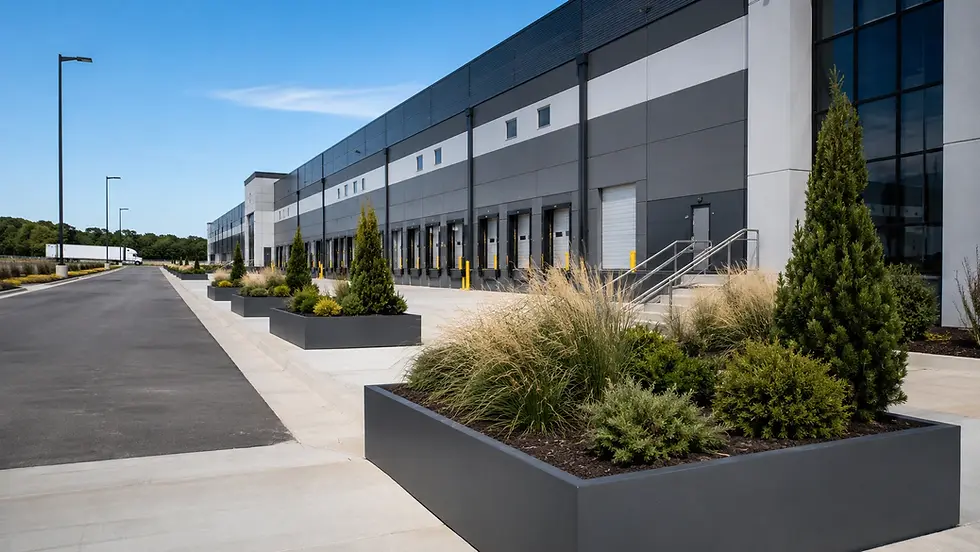
A logistics facility manager is not thinking about aesthetics the way a hospitality client does. The priorities are perimeter definition, entrance identification, truck route visibility, and a landscaping spend that a facilities budget can defend. Distribution centers and industrial parks also tend to have larger, flatter footprints with fewer sheltered microclimates, so planters sit in full sun, full wind, and full winter exposure with almost no manual watering or seasonal swap-outs planned into the maintenance contract.
This is a segment Urban Pot's guide to commercial planters for outdoor office spaces touches on from the corporate-campus side, but a warehouse entrance or a Class A logistics park in Mississauga or Brampton has different load, budget, and durability constraints than a downtown office plaza.
According to NAIOP, the industry association that grew out of the original National Association of Industrial Parks, professional site presentation has been part of industrial park planning since the sector's earliest standards were written in the 1960s, and it remains a factor in tenant retention today.
What "Low-Maintenance" Actually Means for a Logistics Site
Low-maintenance is not the same as low-quality. For a facilities manager, it means:
No irrigation dependency once plants are established
No repainting, rusting, or cracking after one Canadian winter
No specialized crew needed for seasonal upkeep
A planter that survives being clipped by a forklift or delivery truck without shattering
Urban Pot's fiberglass planters meet the first three criteria directly: the material is frost-resistant, non-corrosive, and requires no repainting cycle. For higher-traffic zones near loading docks, our standard architectural planters in marine-grade aluminum or high-performance concrete add the impact resistance a busy yard demands. Both material families are engineered for the freeze-thaw cycles that define a Canadian winter, from Halifax to Calgary.
Material Comparison for Industrial and Logistics Sites
Material | Maintenance Level | Freeze-Thaw Resistance | Approx. Lifespan | Best Use on a Logistics Site |
Marine-grade aluminum | Very low | Excellent | 15+ years | Entrance identification, guard shack zones |
Fiberglass | Very low | Excellent | 10-15 years | Perimeter runs, loading dock islands |
High-density resin | Low | Good | 8-12 years | Budget-phase perimeter fill, temporary yard zones |
Note: lifespan figures assume standard outdoor exposure with seasonal debris clearing only, no irrigation or repainting. Facilities in coastal or high-salt-spray zones should request marine-grade aluminum specs specifically. Urban Pot can supply freeze-thaw performance data and wet-weight material spec sheets for any of the above on request, which most facilities teams need before a bid goes out.
Budgeting: Positioning Cost Against a Facilities Manager's Reality
Distribution center landscaping budgets are usually justified against property management or tenant-retention line items, not marketing spend. That makes upfront cost per unit less important than cost per year of service. Urban Pot's cost vs. value breakdown of commercial planters walks through how material choice, size, and installation complexity affect the real ROI of a planter program, and the same math applies to a logistics park perimeter as it does to a retail plaza.
Industrial real estate in Canada is not slowing down enough to make this a niche question. Reporting on the Toronto industrial market points to sustained demand for distribution space driven by e-commerce and last-mile delivery growth, which means more logistics parks, more entrances to define, and more facilities managers being asked to spec landscaping on a tight capital budget. A planter program that avoids yearly replacement costs pays for itself inside two or three winters.
For sites managing stormwater runoff from large paved yards, it is also worth reviewing Urban Pot's bioretention planters and stormwater ROI guide, since perimeter planting at a distribution center can double as runoff management without adding a separate line item. Framing the request this way, as a multi-year facilities cost rather than a one-time landscaping purchase, also tends to move faster through procurement, since it lines up with how most property management budgets are already structured.

Where Planters Belong on a Distribution Center Site
Placement matters as much as material on an industrial site. The highest-value locations are:
Main entrance and guard shack — this is where visitors, drivers, and tenants form their first impression of the facility.
Loading dock perimeter — planters here need impact resistance more than aesthetics; Urban Pot's contractor-facing specs cover CAD files and structural load data for this kind of installation.
Truck route edges — used to define circulation without hard barriers, keeping sightlines open for reversing vehicles.
Tenant signage zones — smaller accent planters that reinforce wayfinding without competing with directional signage.
Each of these zones carries a different risk profile, and that should drive the spec, not just the layout. An entrance planter rarely gets clipped by equipment, so a lighter fiberglass unit with a taller profile works well for visibility from the road. A loading dock planter, by contrast, sits within the working radius of forklifts, delivery trucks, and reversing trailers, so it needs enough mass and impact tolerance to survive an off-center hit without cracking or shifting out of position. Truck route edge planters are often specified in continuous modular runs rather than single units, which keeps the sightline consistent for drivers while still defining the boundary clearly enough that no one treats it as drivable pavement.
Landscape contractors and design-build firms working across multiple industrial sites can review Urban Pot's specs for landscapers and architects for bidding support, modular sectioning for large perimeters, and RAL color matching to tenant branding. Urban Pot also produces custom planters sized to nonstandard perimeter dimensions, which comes up often on industrial sites with irregular loading configurations. Our full planter types catalogue breaks down every shape and application by project type.
Planting Choices That Actually Survive an Industrial Site
The planter material solves half the maintenance equation. The other half is what goes inside it. Distribution centers rarely have a horticulture budget, so plant selection needs to lean hard on drought tolerance and cold hardiness rather than seasonal color rotation.
Ornamental grasses, junipers, and other low-water evergreens hold their structure through a Canadian winter without needing replacement each spring, which keeps the total cost of the planter program close to the material cost alone. Avoid anything that requires deadheading, staking, or a defined watering schedule; if a plant needs attention more than twice a season, it does not belong on a logistics perimeter with no dedicated grounds crew.
Facilities managers specifying at scale across multiple sites should standardize on two or three plant varieties per zone type so that replacement stock is predictable and easy to source regionally. This also simplifies vendor conversations at renewal time, since a grounds crew quoting on three known species can price and source faster than one working from a mixed, site-by-site planting list.
Facilities teams evaluating a multi-site rollout can reach team@urbanpot.com directly for that documentation.
Frequently Asked Questions
Q: How much maintenance do industrial park planters actually need?
Fiberglass and marine-grade aluminum planters need only seasonal debris clearing and occasional pruning. There is no repainting, no drainage repair, and no irrigation system to run once plants are established, which fits a facilities budget with no dedicated landscaping crew.
Q: What is the most budget-friendly low-maintenance material?
High-density resin offers the lowest upfront cost while still resisting cracking and fading. It suits perimeter fill on a phased budget, though fiberglass or aluminum deliver a longer service life for entrance and loading dock zones.
Q: Can planters withstand Canadian winters at a warehouse entrance?
Yes. Marine-grade aluminum and fiberglass planters are built for freeze-thaw cycles across Canadian climates, from coastal salt exposure to prairie cold snaps, without cracking, rusting, or repainting.
Q: Do distribution centers need irrigation for planter landscaping?
No irrigation is required once plants are established in a properly drained planter. Urban Pot's engineering includes drainage management specifically to prevent water stagnation without an active watering system.
Q: Are custom sizes available for irregular loading dock perimeters?
Yes. Urban Pot builds custom planters to match nonstandard perimeter lengths and dock configurations, which is common on industrial sites where standard modular sizing does not fit the footprint.
Low-Maintenance Planters for Industrial Landscaping: Next Steps
Distribution centers and industrial parks need a planter strategy built around durability and budget defensibility, not seasonal display. Urban Pot's fiberglass and aluminum lines are engineered specifically for that brief, and our team works directly with facilities managers, contractors, and design-build firms specifying landscaping for logistics sites across Canada.


