

Powder-Coated Finish Quality: What to Look for in Commercial Planters
TL;DR
Powder coating is a dry finishing process where electrostatically charged powder is applied to a metal surface and cured under heat, producing a finish that resists chipping and fading better than wet paint. Quality is measured against the AAMA 2603, 2604, and 2605 standards, which set testing requirements for salt spray resistance, color retention, and gloss retention. Urban Pot's aluminum planters use an exterior-grade, UV-resistant powder coat applied by AAMA-certified applicators, in a standard color palette plus custom RAL matching.
Powder coating is a dry finishing process in which electrostatically charged powder particles are applied to a grounded metal surface, then cured under heat to form a bonded protective layer. It's distinct from wet paint, which is applied as a liquid and cures through solvent evaporation, and the difference shows up directly in how each finish holds up outdoors.
Urban Pot manufactures powder-coated aluminum planters for commercial and institutional projects across Canada and the United States. This guide covers how powder coating works, what the AAMA performance standards actually test for, and what to confirm before specifying a finish for an outdoor commercial project.

How Powder Coating Works
The process starts with surface preparation, cleaning the metal to remove oils, rust, and contaminants so the coating can bond properly. Aluminum typically also goes through a conversion pretreatment step before coating, which improves adhesion between the aluminum surface and the powder film.
Powder, a dry mix of pigment and resin, is then applied using an electrostatic spray gun, which gives each particle a charge so it's drawn evenly onto the grounded metal surface, including into corners and recesses that a liquid spray can miss. The coated piece goes into a curing oven, where heat melts the powder and fuses it into a continuous film.
This is where powder coating's main advantage over wet paint comes from. Because the coating cures as a single fused layer rather than a liquid film that dries and shrinks, it resists chipping and cracking in a way wet paint doesn't, and it holds color and gloss longer under UV exposure.
It also produces a thicker, more consistent film than most wet-paint applications, which is part of why it's become the standard finish for outdoor commercial metal furnishings, planters included.
Common Powder-Coat Finish Failures and What Causes Them
Knowing what a failing finish looks like makes it easier to evaluate whether a coating was properly specified and applied in the first place.
Chalking. A powdery residue that develops on the surface as UV exposure breaks down the resin. Lower-tier coatings chalk faster; it's one of the visible signs a finish was under-specified for its exposure level
Filiform corrosion. Thread-like corrosion that develops under the coating, usually starting at a cut edge, scratch, or fastener point where the coating wasn't fully sealed during application
Color fade and gloss loss. Gradual dulling and color shift under sustained UV exposure; this is exactly what the AAMA gloss-retention and color-change testing is designed to measure and limit
Chipping at edges and joints. More common where the coating film is thin or where two coated surfaces meet and flex against each other over time
Orange peel texture. A bumpy, uneven surface texture caused by incorrect curing temperature or time, rather than a material defect in the powder itself
A finish that shows any of these within its expected service life is a signal to review the original specification, not just the individual unit.
The AAMA Standard: 2603 vs. 2604 vs. 2605
Powder coat quality on architectural aluminum is measured against three tiers published by the American Architectural Manufacturers Association (AAMA). They're differentiated primarily by how long the coating is tested against outdoor weathering, not just the coating chemistry itself.
AAMA 2603 is the entry tier, typically used for residential applications, and requires the shortest period of South Florida weathering exposure testing. It's suited to applications with limited outdoor exposure, not long-term architectural use.
AAMA 2604 is the mid tier, used for high-end residential and most commercial and industrial applications, and requires several years of weathering exposure testing. This is the tier most commercial outdoor furnishings, planters included, are specified against.
AAMA 2605 is the top tier, reserved for monumental and architectural projects with the highest exposure demands, such as coastal or severe-climate installations, and requires the longest weathering exposure testing of the three. It also typically requires a different resin chemistry (fluoropolymer-based) to meet the standard, which is why 2605-rated coatings cost more than 2603 or 2604.
None of the three is universally "better." A 2605-rated finish on a project that doesn't need it is an unnecessary cost; a 2603-rated finish on a coastal-exposed commercial project won't hold up to spec.
What to Ask for in a Powder-Coat Finish Spec
A finish being called "powder coated" doesn't say much on its own. Before specifying, confirm the following directly with the manufacturer:
AAMA tier. Which of 2603, 2604, or 2605 the finish is actually rated to, not just "AAMA compliant" in general terms
Salt spray resistance. The number of hours the coating withstands under ASTM B117 salt spray testing
Gloss and color retention. Expected gloss retention percentage and color change (measured as Delta E) after a stated exposure period
Film thickness. The dry film thickness (DFT), usually measured in mils or microns
Adhesion testing. Whether the coating has been tested under a standard like ASTM D3359 for adhesion, confirming it won't peel or flake under stress
Applicator certification. Whether the coating was applied by an AAMA-certified applicator, since the same powder chemistry performs differently depending on prep and application quality
Asking for the specific figures, rather than accepting "premium powder coat finish" as a description, is what separates a specification a project can actually hold a manufacturer to from marketing language. Urban Pot's full technical documentation, including finish performance data, is available through the BIM and Specification Library.
How Urban Pot's Powder-Coat Finish Is Specified
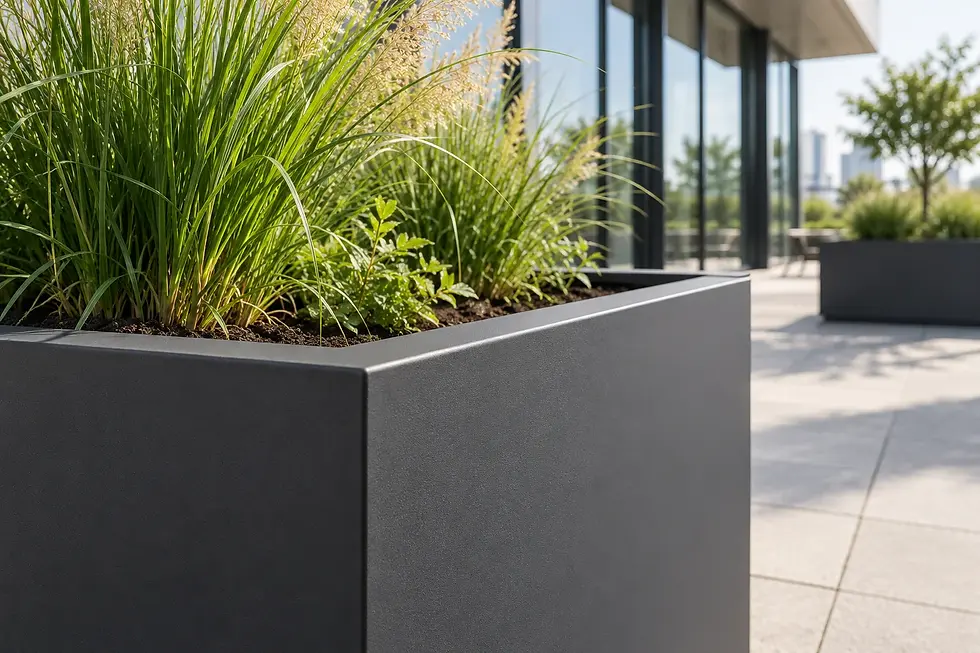
Urban Pot's Standard Aluminum Planters use an exterior-grade, UV-resistant powder coat, applied to both the interior and exterior of the planter. The coating is applied by AAMA-certified applicators, and finishes are tested for adhesion under ASTM D3359, with no removal under standard test conditions.
Finish performance figures reflect the AAMA class a coating is specified to, not lot-specific test results. Lot-specific certified test reports are available on request for projects that need them for submittal documentation.
Color Matching and Custom RAL
Urban Pot offers a standard palette of powder-coat colors alongside custom RAL color matching for projects that need to match an existing brand or building palette, the same consideration that comes up when ordering custom logo planters for a franchise or corporate rollout. Because color reproduction varies between screens, printed material, and the actual cured powder finish, this creates a real risk of mismatch between what's specified and what arrives.
Urban Pot's own documentation recommends confirming any color selection against manufacturer master chips before finalizing a specification, the same standard practice any powder-coat manufacturer should support.
Projects requiring an exact brand-match color should request a color confirmation as part of the submittal process, rather than specifying from a printed or on-screen color swatch alone.
Maintaining a Powder-Coated Finish
Powder-coat finishes need minimal upkeep, but a little routine care extends the finish life closer to what the AAMA tier is actually rated for. Urban Pot's care guidance for its powder-coated aluminum planters includes cleaning with a mild, pH-neutral detergent and a soft cloth or sponge, then rinsing with clean water, while avoiding abrasive cleaners, solvents, ammonia, and bleach, all of which can dull or strip a powder-coat finish over time.
Salt and fertilizer residue are corrosive to metal planters and should be rinsed off rather than left to pool at the base. Unlike coatings on ferrous (iron-based) substrates, chips in a powder-coat finish on aluminum don't tend to propagate outward from the damage point, but they should still be repaired promptly for appearance, and color-matched touch-up kits are available on request for standard colors. An annual visual inspection is enough to catch most issues before they become a specification concern.

Frequently Asked Question
What's the difference between AAMA 2604 and 2605 powder coat?
AAMA 2604 is tested for several years of outdoor weathering exposure and covers most commercial applications. AAMA 2605 is tested for a longer exposure period and is reserved for monumental or severe-exposure projects, typically using a fluoropolymer-based resin that costs more than 2604-tier coatings.
Does powder coating last longer than wet paint outdoors?
Generally, yes. Powder coating cures as a fused, continuous film rather than a liquid film that dries and shrinks, giving it better resistance to chipping and better long-term color and gloss retention under UV exposure.
How do I confirm a powder-coat finish meets a specific AAMA tier?
Ask the manufacturer directly for the AAMA tier number, and request lot-specific certified test reports if the project's submittal documentation requires them. A general claim of "AAMA compliant" without a tier number isn't a verifiable specification.
What causes a powder-coat finish to fail early?
The most common causes are under-specifying the AAMA tier for the site's actual UV and weather exposure, incomplete coverage at cut edges or fastener points, and incorrect cure temperature during application. Chalking, color fade, and edge chipping are the visible signs to watch for.
Specifying Powder-Coated Planters for Your Project
Powder coat quality isn't something a finish description alone can confirm. Specifying against a named AAMA tier, and asking for the salt spray, gloss retention, and adhesion figures behind it, is what makes a finish specification something a project can actually hold a manufacturer to.

