

Security Planters vs. Bollards: Choosing the Right Perimeter Barrier
TL;DR
Bollards are purpose-built, crash-tested hardware for sites that need certified, documented vehicle-impact protection. Security planters are heavy architectural barriers that deter and slow unauthorized vehicle access while defining space and adding landscaping value, making them the better fit for storefronts, plazas, and mixed-use sites that don't require certified impact ratings. Urban Pot's planters fall into this second category: they're built for architectural perimeter management, not as a substitute for certified crash-rated security hardware.
A security planter is a heavy, often concrete-ballasted planter used to manage vehicle and pedestrian flow around building entrances, pedestrian zones, and site perimeters. A bollard is a fixed or removable post, typically steel, installed for a similar purpose but with no landscaping function. Both show up across commercial and public sites in North America, though the term "security planter" covers a wide range of products, from fully certified, crash-tested units to architectural planters used purely as deterrents.
Urban Pot manufactures heavy-duty custom planters for commercial and institutional projects across Canada, including sites in Quebec and Ontario that want a substantial architectural perimeter barrier without an industrial look. These are architectural deterrent and space-delineation products, not certified crash-tested security hardware, and this guide is written with that distinction upfront.
Choosing between a planter, a bollard, or a hybrid comes down to one question: does the site require certified, documented impact resistance, or does it need a barrier that manages access and defines space while doing something useful for the site's design?
This guide breaks down where each option fits and what to confirm before specifying any of them, drawing on the same specification standards covered in our guide to frost-resistant planters for Canadian commercial projects.
What Is an Architectural Security Planter?
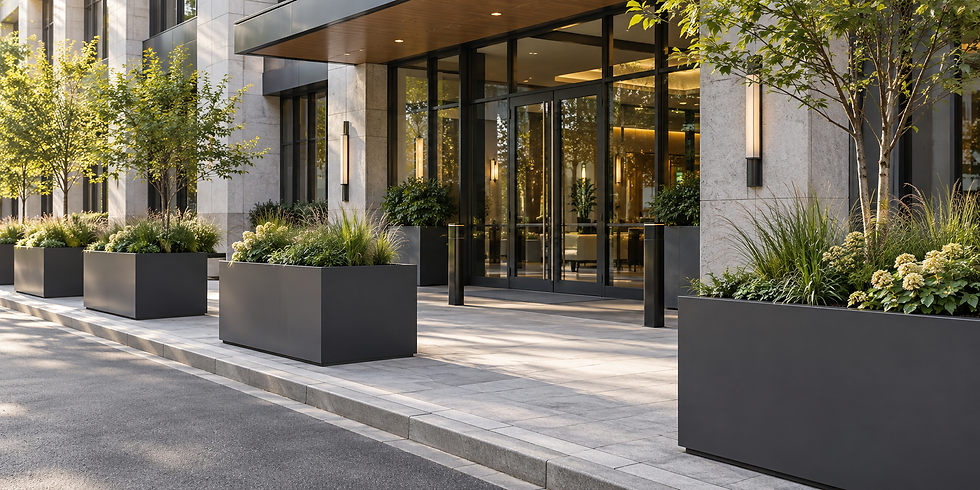
An architectural security planter is a large-format planter, typically built from reinforced concrete, fiberglass over a steel or concrete core, or heavy-gauge metal, that uses substantial weight and ballast to physically deter and slow unauthorized vehicle access. Unlike a decorative planter, it's sized and weighted to close gaps between fixed structures and hold its position under normal conditions.
It's important to be precise about what this does and doesn't mean: mass and placement provide a physical deterrent and can slow or redirect an errant or low-speed vehicle, but that isn't the same as a certified crash rating.
A certified rating only comes from third-party crash testing to a standard like ASTM F2656 or F3016. Products marketed as "security planters" span both categories, and a buyer needs to know which one they're looking at before specifying it for a site with a real vehicle-threat requirement.
Because the outer shell is a planter, the unit also does double duty: it can hold real plantings, seasonal displays, or low-maintenance greenery while managing the perimeter. This is the main reason architects and property managers specify them over a plain barrier. The perimeter measure reads as landscaping first.
Common placements include building entrances, outdoor dining perimeters, plaza edges, and loading zones where a hard industrial barrier would clash with the surrounding design. For sites with existing hardscaping in concrete or stainless steel, matching the planter's finish to the rest of the streetscape is usually part of the spec.
What Is a Security Bollard?
A bollard is a short, vertical post, most often steel-filled with concrete, installed to stop or slow a vehicle from entering a protected area. Bollards can be fixed, removable, or retractable, and certified bollards are rated by the impact speed and vehicle weight they're tested to stop, most commonly under the ASTM F2656 crash-test standard for higher-threat sites or ASTM F3016 for lower-speed storefront applications.
Certified bollards are the default choice where documented, tested impact resistance is a hard requirement. Government buildings, transit stations, stadiums, and other sites where a security consultant or authority having jurisdiction specifies a minimum crash rating all fall into this category.
This pattern is covered in more detail in our stadium and arena planters guide. They install in a fixed line, spaced close enough to prevent a vehicle from driving between them, and they carry no landscaping function on their own.
Architectural Planters vs. Bollards: Key Differences
The table below compares the two across the factors that typically decide a specification. It assumes an architectural, non-certified security planter, which is what most commercial projects are actually comparing against certified bollards.
Factor | Architectural Security Planters | Certified Bollards | Planter Bollards (Hybrid) |
Vehicle Impact Protection | Not certified or crash-tested; mass and placement provide a physical deterrent, not a documented rating | Purpose-built and crash-tested; commonly rated to ASTM F2656 or F3016 | Combines a certified bollard core with a planter shell for a documented rating |
Aesthetic Integration | High. Doubles as landscaping and softens hard perimeters | Low. Reads as industrial or institutional | Moderate. Planter shell softens the bollard's appearance |
Installation & Permitting | Freestanding, ballast-based; typically no permit for surface placement | Often requires foundation footings and a permit | Similar footing requirements to standard bollards |
Cost & Maintenance | Moderate upfront cost; seasonal planting upkeep if planted | Lower upfront cost; minimal maintenance | Higher upfront cost; low maintenance, no planting required |
Note: Crash ratings only apply to products independently tested to a recognized standard. Confirm test documentation directly with any manufacturer, and confirm site-specific requirements with a structural engineer or security consultant before specifying any barrier type.
Certified bollards win on documented, tested impact resistance, full stop. Architectural planters win on how the space looks and functions day to day, and they still provide a meaningful physical deterrent even without certification.
Where a project has a real, documented vehicle-threat requirement, that's a job for certified hardware. Where the goal is space definition, access management, and site aesthetics, an architectural planter is usually the better fit.
When Certified Bollards Are the Right Choice
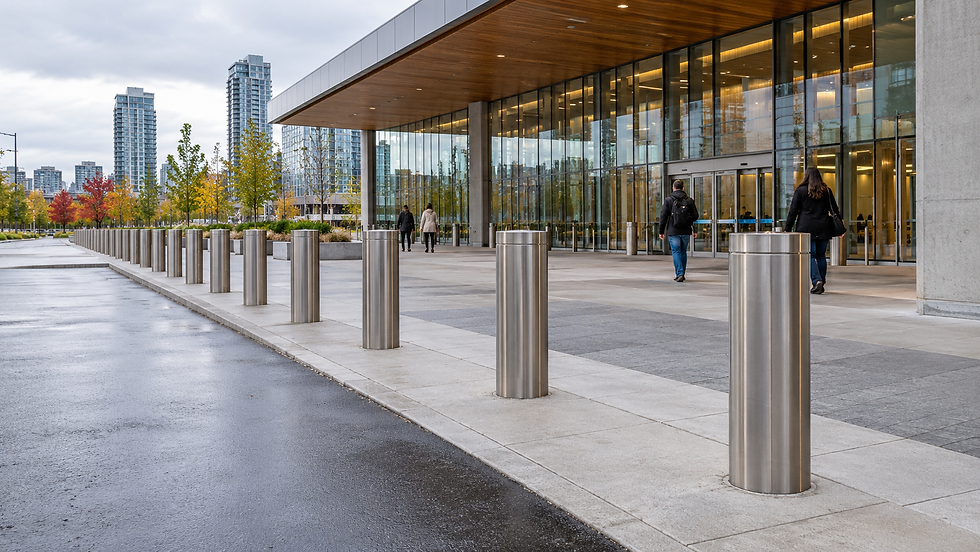
Certified bollards make sense wherever a site has a documented, tested impact-resistance requirement, whether from a security consultant, an insurer, or a code authority.
High-risk or government perimeters. Sites where a security consultant specifies a minimum ASTM crash rating and test documentation is required for compliance
Stadiums and arenas. High pedestrian volume perimeters where fixed, closely spaced, certified bollards are the standard approach, as covered in our stadium and arena planters guide for sites layering landscaping around the bollard line
Loading docks and service entrances. Areas with no landscaping requirement, where a bollard's lower cost and simpler install are the deciding factors
Any site where "crash-rated" appears in the project spec. If a document calls for a specific ASTM rating, that requirement can only be met with independently tested hardware, not an architectural planter
When Architectural Security Planters Are the Right Choice
Architectural planters make sense anywhere the barrier's job is deterrence, space definition, and access management, rather than meeting a documented crash-rating requirement.
Storefronts and retail entrances. A planter reads as landscaping first and a deterrent second, which matters for customer-facing frontage that doesn't have a certified-hardware requirement
Rooftop and plaza applications. Freestanding, ballast-based units avoid the structural coordination that footings for fixed bollards require, a factor covered in depth in our rooftop load restrictions guide for architects
Franchise and multi-location rollouts. A single planter spec can be standardized across locations for both perimeter management and brand consistency, including matching custom logo planters to a brand's ordering guide
Sites with existing landscaping. A heavy architectural planter extends the planting scheme instead of interrupting it with a line of steel posts, often built from resin or concrete to match nearby hardscaping
Urban Pot builds architectural planters for exactly these cases: sites that want substantial, well-placed perimeter management without an industrial look, and without a documented crash-rating requirement to meet.
Our suspensions and modular planter lines offer additional options where ground-level ballast isn't practical. For any project with a certified impact-resistance requirement, that calls for crash-tested bollard hardware instead.
Planter Bollards: The Hybrid Option
Planter bollards pair a certified bollard core with a planter shell, giving a site the documented impact rating of a bollard with the visual softening of a planter. This is the option a project reaches for when a security consultant requires a specific crash rating and the design brief also calls for landscaping at the same location.
The tradeoff is cost and complexity: a planter bollard unit typically costs more than either a standalone bollard or an architectural planter, and installation still requires the footing work a standard bollard needs.
For sites where a certified rating is genuinely required, that added cost is the price of meeting the spec while keeping the landscaping intent. Buyers should confirm directly with the manufacturer which component of a planter bollard carries the certification, since the rating applies to the bollard core and its installation, not the planter shell on its own.
Barrier Planters: What to Confirm Before Specifying

Whichever option a project lands on, a few questions determine whether a "barrier planter" is doing the job the site actually needs.
Does the site have a documented crash-rating requirement? If yes, that requirement can only be satisfied by independently tested hardware such as certified bollards or a planter bollard with a certified core, per standards like ASTM F2656 or F3016. An architectural planter should not be specified as a substitute
Is the manufacturer clear about certification status? Ask directly whether a planter is crash-tested or sold as an architectural deterrent, and get it in writing rather than assuming from the "security" name
Weight and ballast. For architectural planters, confirm dry weight and the ballast method (concrete fill, sand, or built-in mass), since this is what actually determines the physical deterrent value
Anchoring method. Surface-mounted, ballasted, or foundation-anchored, depending on whether the site can accommodate footings
Material and finish durability. Freeze-thaw performance matters for any planter left outdoors year-round in Canadian climates, independent of its perimeter function, as detailed in our frost-resistant planters guide
Drainage, if planted. A perimeter planter that's also functioning as a planter still needs proper drainage to avoid frost damage to the shell; see our metal planters line for integrated drainage options.
Specifying by name alone, assuming "security planter" means certified, is the most common way a project ends up with a barrier that looks the part but was never tested to stop anything. Confirming certification status upfront avoids that gap.
Frequently Asked Question
Are security planters as effective as bollards?
Not for certified impact resistance. Architectural security planters provide a physical deterrent through weight and placement, but only independently crash-tested hardware carries a documented rating. Confirm certification status directly with any manufacturer before assuming equivalence.
Do security planters need a permit?
Most freestanding, ballast-based architectural planters don't require a permit since they're not anchored to the foundation. Fixed or foundation-anchored installations, including certified bollards, may need one. Check with the local municipality.
What's the difference between a security planter and a planter bollard?
An architectural security planter is a standalone, ballasted unit that deters and slows unauthorized access without a certified rating. A planter bollard combines a certified bollard core inside a planter shell, giving a documented crash rating along with a landscaped appearance.
Can architectural planters be used on rooftops?
Yes, provided the rooftop's load capacity accommodates the planter's ballasted weight. A structural engineer should confirm load limits before specifying.
Do architectural security planters require ongoing maintenance?
If planted, they need the same seasonal upkeep as any commercial planter. The ballast and shell require minimal maintenance beyond routine inspection.
Choosing the Right Perimeter Barrier for Your Commercial Site
Certified bollards remain the right call anywhere a site has a documented, tested impact-resistance requirement. For most commercial storefronts, plazas, and multi-location projects that need perimeter management, access control, and landscaping value rather than a certified crash rating, an architectural security planter is the better fit, and a planter bollard covers sites that need both.


