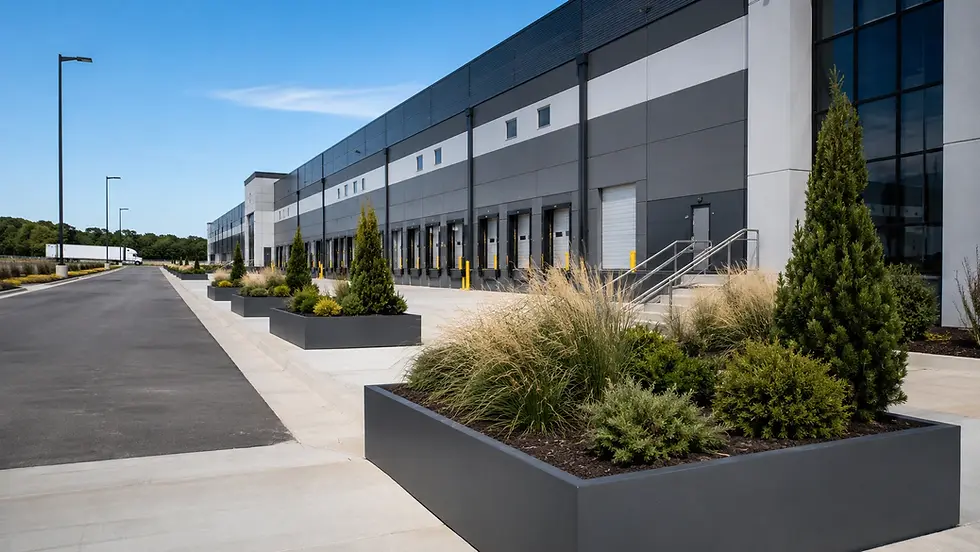
Durable Outdoor Planters That Won't Crack in Any Climate
Updated: Sep 8
A durable outdoor planter is one built to withstand the specific stress of its site, whether that's repeated freezing and thawing, direct summer sun, wind, or simply years of daily weather. Not every planter that looks sturdy actually holds up, and the material that survives one climate can fail in another within a season or two.
Urban Pot designs and manufactures custom outdoor planters for residential, commercial, and municipal projects across Canada and the United States, in materials built to perform through four full seasons, from coastal winters to Prairie summers.
This guide breaks down what actually makes a planter durable, compares the materials worth considering, and covers the two questions we see searched most: why planters crack, and whether resin holds up.

Why Outdoor Planters Crack or Fail
Most planter failures come down to one mechanism: water gets into the material, freezes, and expands. Water expands by roughly 9 percent when it turns to ice, and in a porous material like untreated terracotta or standard concrete, that expansion pushes outward from the inside until the wall gives way, usually starting as a hairline crack that widens with every freeze-thaw cycle that follows.
This is also why a "cold-hardy" label on its own can be misleading. A USDA Plant Hardiness Zone tells you which plants will survive your winter, but it says nothing about whether your planter material will survive the same conditions. A University of Nevada Reno Extension guide on winterizing containers makes the same distinction: knowing your hardiness zone matters for plant selection, but the container itself needs a separate evaluation based on its material, wall thickness, and drainage.
Heat causes a different kind of stress. Materials expand and contract with temperature swings, dark and metal surfaces can raise soil temperature enough to stress roots, and UV exposure gradually breaks down pigments and, in some plastics, the material itself. It's slower and less dramatic than a pot cracking after a hard freeze, but it shows up over years as fading, chalking, or brittleness.
Drainage plays a role in both. A planter that sits with standing water at its base freezes with that water trapped against the walls, and the same standing water accelerates rot and staining in hot, humid conditions. A drain that moves water out quickly reduces stress from both directions.
Wind and impact are the third stress worth considering, particularly for taller or narrower planters. A lightweight material like resin or thin-gauge fiberglass can be knocked over or scraped by foot traffic and equipment in ways a heavier aluminum or concrete planter resists. This matters most for exposed rooftop or streetscape placements, where wind load and accidental contact are more likely than in a sheltered backyard.
Material Durability Comparison
The table below compares four materials commonly used for outdoor planters, weighing how each performs against freeze-thaw stress and UV exposure over time.
Material | Freeze-Thaw Resistance | UV/Fade Resistance | Best For | Maintenance |
Aluminum | Doesn't absorb water, so freeze-thaw expansion isn't a structural risk to the shell | Standard powder coat fades in 5–7 years; super-durable TGIC finish holds 10–15 years | Rooftops, high-traffic commercial sites | Low, occasional wash |
Fiberglass | Non-porous shell flexes slightly with freeze-thaw movement instead of cracking | Gel-coat rated 10–15 years before noticeable fade | Rooftops and weight-restricted areas | Low |
Concrete | Porous; prone to spalling over repeated cycles unless sealed and properly drained | Holds color well, minimal fade | Permanent, ground-level installations | Low, occasional sealing |
Resin | Resists cracking better than untreated clay, though quality varies by formulation | UV-stabilized resin resists chalking; unstabilized resin degrades faster under direct sun | Budget-conscious residential and light-commercial use | Low |
Corten Steel | Structurally stable through freeze-thaw cycles; oxide layer is unaffected by frost | No UV-driven fade; rust patina darkens and stabilizes over 1–3 years, then holds indefinitely | Streetscapes, ground-level plazas, and industrial-adjacent commercial sites | Low, no coating to reapply; occasional salt rinse and drainage check |
GFRC | Tested per ASTM C666, showing only minor scaling after 300 cycles; flexural strength up to 4,000 psi | Holds color well; glass fiber reinforcement resists the surface degradation standard concrete is prone to | Design-forward sites wanting a concrete aesthetic with tested cold-climate durability and lower weight than cast concrete | Low; less prone to spalling than standard concrete, so sealing needs are reduced |
Note: wall thickness, gauge, and finish grade vary by manufacturer and affect real-world performance beyond what a material name alone tells you. Confirm specific product specs before ordering for a site with extreme seasonal swings.

Are Resin Planters Actually Durable?
Resin comes up often enough in questions like "are resin planters durable" and "pros and cons of resin planters" that it deserves a direct answer: yes, quality resin planters are durable for most residential and light-commercial applications, with a few caveats worth knowing before buying.
Modern resin planters are typically made from a UV-stabilized polyethylene or polypropylene blend, which resists the cracking that affects porous materials like terracotta and the brittleness that affects lower-grade plastics. The tradeoff is quality variance across the resin category.
A planter made without UV stabilizers can chalk, fade, or become brittle within a season or two of direct sun exposure, following the same outdoor weathering mechanics described in ASTM D1435, the industry standard practice for testing how plastic materials hold up outdoors.
Pros of resin: lightweight and easy to move, budget-friendly relative to metal or GFRC, resistant to the freeze-thaw cracking that affects clay and basic concrete, available in finishes that convincingly mimic concrete or terracotta.
Cons of resin: lower-end products can fade or turn brittle under prolonged UV exposure, generally not rated for the structural loads that metal or fiberglass planters handle on rooftop and high-traffic commercial sites, and quality is harder to judge at a glance than with metal or fiberglass.
For homeowners and light-commercial buyers prioritizing budget and easy handling, Urban Pot's resin planters are a reasonable, genuinely durable choice as long as they're UV-stabilized. For commercial specification work with structural load requirements, the metal and fiberglass lines remain the better fit.
Winter Durability, Wherever You Are
Winter is the single biggest driver of planter failure, and it's not limited to any one region. Whether the concern is a mild coastal freeze-thaw cycle or a sustained deep freeze, the same principle applies: materials that don't absorb water, like aluminum and fiberglass, are inherently more resistant to freeze damage than porous materials like untreated terracotta or standard concrete.
Beyond material, three habits extend a planter's winter life regardless of climate: keep drainage clear so water doesn't sit and freeze against the walls, avoid leaving a planter fully saturated going into the first hard freeze, and elevate the base slightly to prevent it from sitting directly on frozen ground.
For Canadian commercial and municipal projects with specific freeze-thaw cycle requirements, wall thickness standards, and drainage engineering details, see Urban Pot's guide to specifying frost-resistant planters for Canadian commercial projects, which covers the technical side in depth.
Heat & UV Exposure
Heat and sun damage a planter more slowly than a hard freeze, but the effects add up. Direct summer sun breaks down pigments over time, which is why fade resistance varies so much by material and finish, from the 5 to 7 year fade window on standard aluminum powder coat to the 10 to 15 year range on both super-durable TGIC finishes and fiberglass gel-coat.
Dark and metal finishes also absorb more heat than light-colored materials, which can raise soil temperature enough to stress roots in extended full-sun placements like rooftops or south-facing plazas. Lining a dark planter or choosing a lighter finish for full-sun installations helps offset this. Moisture loss speeds up in the same conditions, so full-sun planters generally need more frequent watering than the same setup in partial shade.
Signs a Planter Won't Survive the Season
A few warning signs are worth checking before winter or a stretch of intense summer heat sets in, especially on planters bought without a manufacturer spec sheet:
Hairline cracks near the base or corners, often invisible until a pot is emptied for the season. These widen with every freeze-thaw cycle that follows.
Standing water that doesn't drain within a few minutes of a heavy watering or rainfall, a sign the drain is undersized, clogged, or missing entirely.
Chalky residue or color loss on the surface, which signals UV breakdown has already started, particularly on lower-grade plastic or unsealed concrete.
A pot that feels lighter or more flexible than expected for its material, which can indicate a thinner wall or lower-grade formulation than advertised.
None of these are reasons to panic mid-season, but they're worth addressing before the next freeze or the next stretch of full summer sun, since damage compounds with each cycle rather than staying static.
Choosing the Right Planter for Your Climate
The right material depends less on a single "durable" label and more on which specific stress a site experiences most. Rooftops and weight-restricted areas call for aluminum or fiberglass, since neither adds significant dead load and both resist freeze-thaw expansion.
Permanent, ground-level installations that see heavy freeze-thaw cycling do well with aluminum, fiberglass, or well-drained GFRC, which holds up to repeated cycles better than standard cast concrete.
Budget-conscious residential and patio use is well served by UV-stabilized resin, provided the product specifies UV stabilization rather than just "weather resistant" on the label. High-traffic commercial and municipal sites benefit from the structural durability of aluminum, corten steel, or fiberglass, detailed further in the frost-resistant planters guide linked above.
Coastal sites add a second variable worth factoring in alongside freeze-thaw and heat: salt exposure, whether from ocean air or winter de-icing near sidewalks and parking areas. Powder-coated aluminum and sealed fiberglass both resist salt corrosion better than untreated metal or porous concrete.
Drainage and installation details matter as much as material choice in every case. A premium material with poor drainage will still fail early, while a well-drained, correctly installed mid-range material can outlast expectations. A drain assembly sized to the planter's volume, paired with a small air gap between the base and the ground or roof surface, addresses most of the failure points covered in this guide at once.
Frequently Asked Questions
What is the most durable planter material for winter weather?
Aluminum and fiberglass hold up best across most climates because neither absorbs water, so freeze-thaw expansion isn't a structural risk to the shell itself.
Are resin planters durable?
Yes, if UV-stabilized. Quality resin resists freeze-thaw cracking and holds up well outdoors, though lower-end, non-stabilized resin can fade or turn brittle in direct sun.
What outdoor planters won't crack in winter?
Non-porous materials like aluminum, fiberglass, and UV-stabilized resin resist winter cracking far better than untreated terracotta or unsealed concrete.
Do outdoor planters fade in direct sunlight?
Yes, to varying degrees. Standard aluminum powder coat fades in 5 to 7 years, while super-durable TGIC finishes and fiberglass gel-coat typically hold color for 10 to 15 years.
How often do durable outdoor planters need maintenance?
Very little. Aluminum, fiberglass, and resin need only occasional cleaning and a periodic drainage check. Concrete benefits from resealing every few years in freeze-thaw climates.
Choosing Durable Outdoor Planters That Actually Last
A planter that survives its climate, whether that means a hard winter, a full-sun rooftop, or just years of daily weather, comes down to the same three factors every time: a material suited to the stress it will face, drainage that keeps water from sitting and freezing or pooling, and realistic expectations about maintenance.
Urban Pot builds outdoor planters in aluminum, fiberglass, concrete, corten steel, and resin for residential, commercial, and municipal projects across Canada and the United States, and provides material guidance on request for projects with specific climate demands.