

High‑Wind Planter Design: Anchoring Strategies for Rooftop Projects
Rooftop environments present significant challenges for commercial design due to high winds and complex structural demands. For architects and developers, securing large-scale greenery is essential for safety and building integrity, not just aesthetics.

Quick takeaway: Rooftop planters must be engineered to resist both lateral and uplift wind forces. This requires selecting durable materials such as marine-grade aluminum or reinforced fiberglass, providing sufficient soil depth and weight, and anchoring the planter to the roof structure using ballast, mechanical fixings, or wind-uplift kits. Wind loads should be calculated in accordance with recognized standards, such as ASCE 7. A structural engineer should review all connection details before installation.
Quick specs for windy rooftop sites
Parameter | Recommended range* | Notes |
Soil depth | Project‑specific (commonly deeper than 18 inches/45 cm for shrubs and small trees) | Adequate soil depth adds mass and buffers roots; exact depth should be determined based on the plant species, planter module, irrigation strategy and roof capacity rather than a universal rule. |
Planter material | Marine‑grade aluminum or reinforced fiberglass | Combines low weight with high structural integrity and corrosion resistance; powder‑coated finishes reduce maintenance. |
Anchoring | Ballast chambers or concealed tie‑downs | Engineered anchoring approaches include ballast compartments, hidden tie‑downs, or proprietary wind‑uplift kits; the appropriate method depends on wind zone, roof construction, and planter design, and should be verified by a professional engineer. |
Placement | Avoid roof edges where possible; offset by plant height when practical | Setting trees back from edges by at least their mature height is a conservative landscape guideline to reduce exposure, but final placement should be based on project‑specific wind analysis and design constraints. |
Wind loading | Determine site‑specific wind loads using ASCE 7/IBC | Calculate both lateral and uplift forces using code‑specified load combinations; the structural engineer may apply additional factors as required by the project. |
*Actual values vary by plant species, planter manufacturer, irrigation strategy and local building code; always consult a structural engineer and the planter supplier to verify design criteria.
Why wind loads matter on rooftop projects
Rooftop gardens are exposed to stronger winds than ground‑level landscapes. Guidelines for rooftop greenery note that high winds can generate both positive and negative pressure on lightweight growth media, and that corners and edges are especially vulnerable. Without proper anchoring, planters and their contents can shift, uplift or topple, posing risks to people and property. The Trees on Rooftops guideline warns that elevated gardens require more robust stabilization than ground‑level plantings; rootballs should be anchored to solid concrete structures using cabling or anchors endorsed by professional engineers. These observations apply equally to large planters: the structure must resist overturning, sliding, and uplift while maintaining waterproofing integrity and meeting loading limits.
Understanding wind loads and standards
The American Society of Civil Engineers’ ASCE 7 standard (adopted in the International Building Code) provides a method for calculating wind loads on rooftop structures and equipment. Designers must consider:
Basic wind speed at the site (from meteorological maps) and exposure category.
Lateral pressure: horizontal forces acting on the side of the planter.
Uplift pressure: suction forces attempting to lift the planter and its contents.
The specific load factors and combinations used in wind design are specified in the applicable building code (e.g., ASCE 7/IBC) and applied by the structural engineer.
In addition to ASCE 7, regional codes such as Singapore’s Building and Construction Authority guidelines require rooftop greenery systems to be secured against uplift. For planters, this means that weight alone is rarely sufficient; connection details must be designed for the site’s specific wind pressures
Material considerations for high‑wind planters
Aluminum and stainless steel planters are well-suited for rooftop applications due to their high strength-to-weight ratio and corrosion resistance. These materials can be fabricated with reinforcing ribs or anchor plates to improve stability. Powder-coated marine-grade aluminum, such as alloy 5052, maintains structural integrity over decades and reflects heat to protect root zones. Reinforced fiberglass offers comparable durability with lower weight and provides natural thermal insulation, which is beneficial where roof load limits are a concern.
Heavier materials such as Corten steel, glass fiber-reinforced concrete (GFRC), or concrete provide resistance to overturning but increase the dead load on the roof structure. Lighter materials like HDPE or wood may be appropriate for sheltered locations but are not recommended for high-wind sites due to lower rigidity and reduced durability. Regardless of material, planters should include internal stiffeners or base plates to enable secure mechanical fastening to the roof structure.
Anchoring strategies
Anchoring solutions for planters in high-wind zones must be tailored to the specific project. The selected system should account for planter size, the building’s structural capacity, and site wind conditions.
Ballast and weight
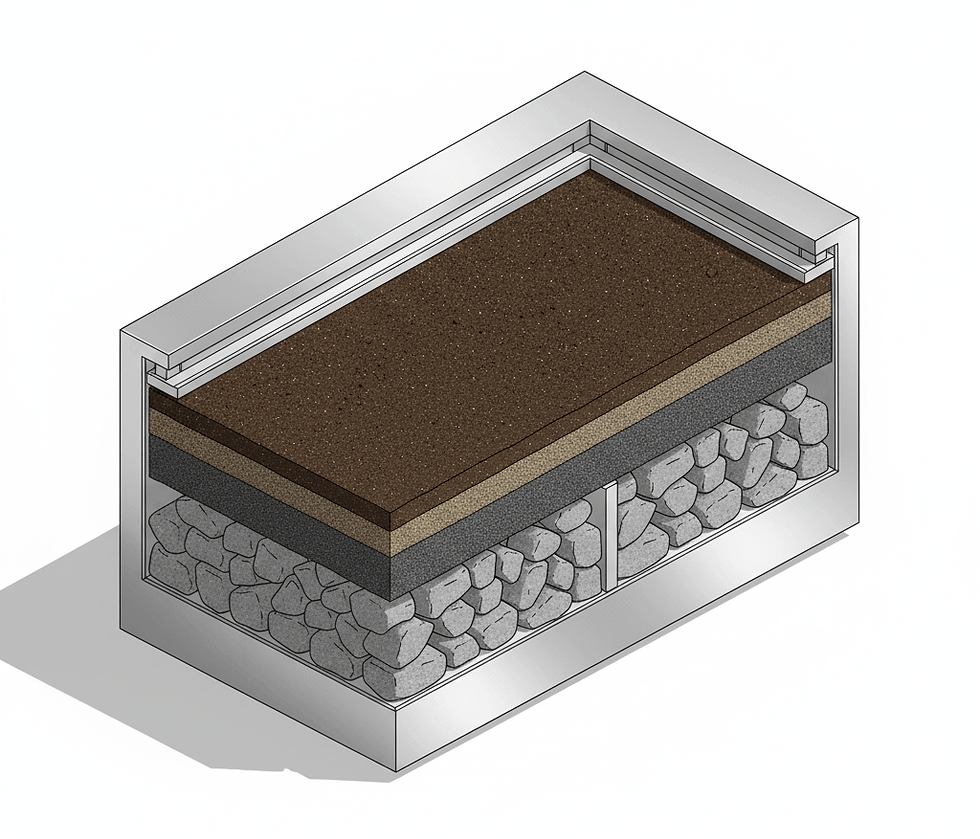
Increasing mass is an effective method to resist overturning and uplift. Commercial planters often feature ballast chambers or double bottoms that are filled with gravel or masonry. Vegetated roof guidelines recommend placing paving slabs or heavy stones at roof edges to secure lightweight growth media. For planters, ballast compartments should be accessible for maintenance and engineered to evenly distribute weight across structural supports, such as joists or columns. Avoid placing excessive weight on mid-span areas.
Mechanical anchorage
Mechanical tie‑downs connect the planter directly to the structural deck or pedestal system. Options include:
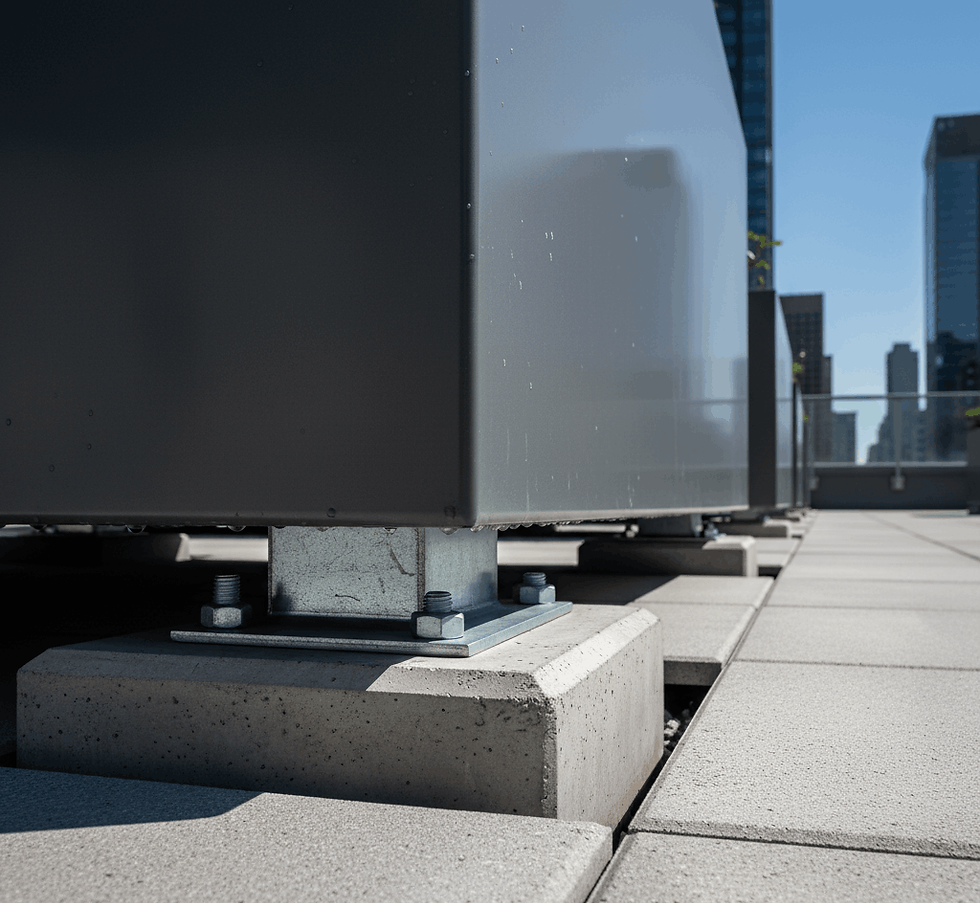
Concealed tie‑down plates or flanges. Planter bases can incorporate hidden steel plates that bolt to rooftop pedestals or structural beams. Fasteners must penetrate only sacrificial layers (e.g., a curb or pedestal) and must not compromise waterproofing membranes. Gaskets, sleeves or curb mounts can isolate anchor bolts from the membrane.
Pedestal or grate systems. Engineered pedestal or grate systems create a monolithic surface that attaches to the roof deck; planters, pavers, and turf are assembled onto the grate and clipped or screwed into place. These systems are manufacturer‑specific examples of how a roofscape can be tied together to resist high winds; suitability must be assessed by the project team.
Cabling and rootball anchoring
For tall plants or small trees, an additional stabilization system may be needed. The Trees on Rooftops guideline recommends that staking and cabling be more structurally sound than for ground‑level landscaping and that rootballs or trunks be anchored to concrete structures using cabling or anchors endorsed by professional engineers. Similar techniques can be incorporated into planters: internal brackets or anchor points allow tree ties to be attached to the planter frame, limiting sway and uplift.
Interlocking and modularity
Large planters may be engineered to interlock or connect, forming a continuous mass that resists movement. Modular systems with lateral braces or locking pins help distribute wind forces across multiple units. When incorporating seating or privacy screens, account for the increased surface area, which can amplify wind loads. Conceal mechanical fixings to preserve the architectural appearance.
Placement and layout
Wind exposure is not uniform across a rooftop. Edges, corners, and parapets are subject to higher uplift and suction forces. As a conservative approach, place heavy planters away from the roof perimeter. For trees, set them back by a distance equal to or greater than their mature height. This guideline is not a code requirement; final placement should be determined by project-specific wind analysis, structural considerations, and site constraints. If planters must be installed at the edge, select shorter units and provide robust anchoring. Grouping planters or aligning them with parapet walls can reduce wind exposure. Avoid continuous rows that may act as wind sails. Adding screens, trellises, or hedges can disrupt wind flow but may require additional anchoring.
Working with structural engineers and contractors
The design of high-wind planter systems is a multidisciplinary task. The Building Design + Construction article on rooftop equipment notes that wind design responsibilities often “fall through the cracks” because mechanical engineers focus on systems while structural engineers worry about the main frame. To avoid similar gaps when designing planters:
Engage a structural engineer early. Verify the roof’s load‑bearing capacity and determine allowable concentrated loads. Place heavy planters directly over beams or columns and distribute weight evenly.
Calculate wind loads. Use ASCE 7 or local code provisions to determine lateral and uplift pressures and apply appropriate safety factors. Provide the engineer with plan dimensions and heights so projected areas can be calculated.
Detail connections. Develop detailed specifications for anchor plates, bolts, straps, and sealants. Ensure that penetrations are coordinated with roofing membranes and warranties.
Coordinate with waterproofing and landscape trades. Anchors, pedestals and ballast must not compromise membranes, drainage or insulation. Consult the planter manufacturer for compatible anchoring hardware.
Maintenance and monitoring
Planters in high‑wind zones require ongoing inspection. Regularly check anchoring hardware, ballast levels, and structural components for corrosion or loosening. Inspect trees and shrubs for canopy density; periodic pruning reduces “sail” area and helps wind pass through. Assess soil moisture and weight—saturated media can increase loads. Engage arborists and horticulturalists for tree risk assessments and adjust anchoring as plants mature. Maintenance plans should document inspection intervals and responsibilities.

Conclusion
Designing planters for high-wind rooftop projects is fundamentally an engineering task focused on protecting the building envelope. Select robust materials such as powder-coated aluminum or reinforced fiberglass. Provide sufficient soil depth to add mass, typically 18 inches or more for shrubs and small trees, with final depth determined by the landscape designer and structural engineer. Anchor planters using concealed hardware or engineered wind-uplift solutions. Base all design pressures on recognized standards such as ASCE 7 or IBC, and consult structural professionals to confirm roof capacity and connection details. With careful design and ongoing maintenance, planters can perform reliably on rooftops exposed to wind.
Urban Pot partners with architects and contractors to create rooftop planter solutions. Reach out to our team to talk about your project needs.
Frequently asked questions
1. How do I determine the wind load for planters on a rooftop?
Wind loads should be calculated using ASCE 7 or local building codes, which provide equations for lateral and uplift pressures on rooftop structures. The calculation considers wind speed, building height, exposure category,, and the projected planter area. A structural engineer can translate these pressures into required ballast weight or fastener capacity.
2. Are heavy planters alone sufficient to resist high winds?
Weight helps, but it is seldom enough on its own. Guidelines for rooftop greenery warn that lightweight media can be uplifted by strong winds and call for measures to secure systems against being lifted. Incorporating ballast, mechanical tie‑downs or wind‑anchor kits ensures that the planter resists both sliding and uplift. Ensure that the added weight does not overload the roof structure.
3. What anchoring methods are appropriate?
Options include filling built‑in ballast chambers, bolting concealed plates to structural supports, using wind‑uplift mats with anchors, and interlocking multiple planters. For taller trees or screens, rootball anchoring and cabling to concrete structures may be necessary. The choice depends on the planter design, roof construction, and wind zone.
4. How far from the roof edge should planters be placed?
The Trees on Rooftops guideline recommends setting trees back from the roof edge by a distance equal to or greater than their expected mature height to create a buffer against gusts. For planters, especially taller ones, consider a similar setback where possible and avoid placing large “sail” surfaces at corners and edges.
5. Do I need a professional engineer for planter anchorage?
Yes. The same guideline notes that anchors or cabling used to stabilize rooftop trees should be endorsed by professional engineers and designed for the tree’s mass at maturity. For planters, a structural engineer will verify roof capacity, calculate wind loads, and design anchoring hardware that integrates with the building structure without compromising waterproofing. This ensures code compliance and protects occupants and property.


