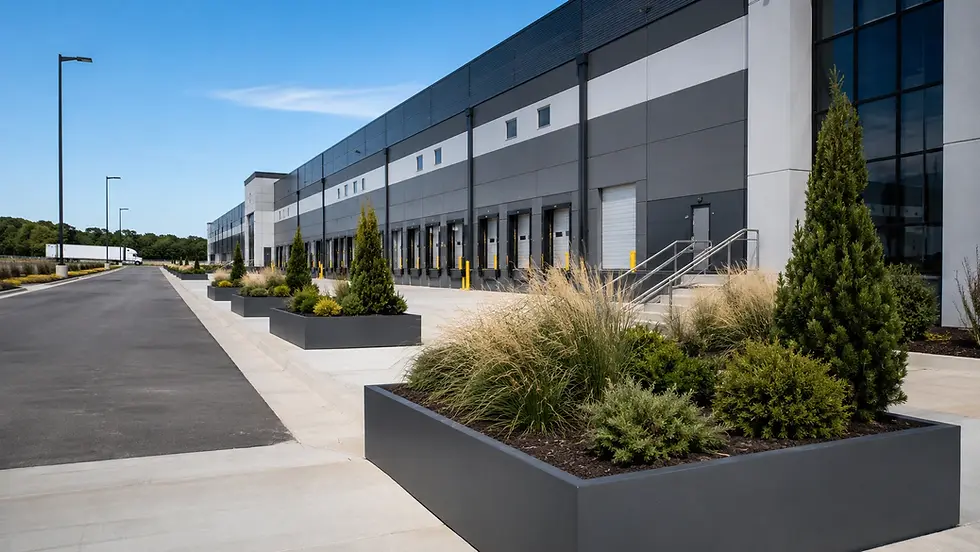
Aluminum Commercial Planters: A Smart Business Investment
- May 12, 2025
- 8 min read
Updated: 11 hours ago
Aluminum commercial planters are large, powder-coated aluminum containers built for storefronts, office entrances, restaurant patios, and other high-traffic commercial exteriors. Unlike residential garden pots, they're engineered for daily wear, exterior exposure across all four seasons, and long service life without repainting or replacement.
Urban Pot manufactures aluminum commercial planters for businesses across Canada and the United States, from single storefronts to multi-location retail chains that need consistent branding at every site.
This guide covers why aluminum performs well as a business investment, what to look for when specifying it, and how it compares to other commercial materials.

Why Aluminum Works for Commercial Exteriors
Aluminum is one of the most practical materials for commercial exterior use. It's lightweight enough to install and reposition without heavy equipment, corrosion-resistant without a protective coating, and holds up across freezing Canadian winters and hot summers without cracking, chipping, or warping.
For a business owner or property manager, that translates into a planter that looks the same in year five as it did on install day, with minimal upkeep required in between.
1. Curb Appeal at the Entrance
A storefront or office entrance is the first thing a customer or client sees. Aluminum planters filled with ornamental grasses, seasonal flowers, or structured shrubs add a polished, intentional look to entrances, walkways, patios, and terraces that a bare storefront can't match.
Well-landscaped commercial exteriors are linked to higher customer dwell time and foot traffic, since inviting outdoor spaces encourage people to slow down and stay rather than walk past.
2. Brand Consistency Across Locations
For multi-location businesses, aluminum planters can be custom powder-coated in specific brand colors and, on larger orders, fitted with etched or applied logos. Because the finish and dimensions can be specified precisely, a franchise or retail chain can install the same planter design at every location and get a matching look site to site, something harder to guarantee with materials like wood or resin that vary more in finish and weathering.
3. Customer Experience and Perceived Value
Greenery at an entrance or seating area does more than look good. It softens hard exterior surfaces, gives outdoor seating a more finished feel, and signals that a business invests in its physical space. For hospitality, retail, and office properties where outdoor seating or queuing areas are part of the customer experience, well-placed planters make that time outside feel more deliberate.
4. Durability That Reduces Long-Term Costs
Aluminum doesn't rust, crack, or warp the way wood, plastic, or untreated steel can over a Canadian winter. It requires no sealing, staining, or repainting cycle. For a property manager budgeting exterior maintenance across a portfolio, that means fewer replacement cycles and fewer maintenance callouts compared to materials that need seasonal upkeep.
5. Custom Sizing for Any Commercial Footprint
Whether the project is a small café patio, a hotel entrance, or a large retail plaza, aluminum planters are available in standard and fully custom dimensions. Their modular fabrication also makes it straightforward to scale a design up if a business expands to a larger space or adds locations. Urban Pot's custom planters for commercial use guide covers the range of sizing and configuration options available.
6. A Recyclable, Lower-Impact Material
Aluminum is fully and repeatedly recyclable without losing material quality, and many commercial aluminum planters, including Urban Pot's, are manufactured using recycled content. For businesses tracking sustainability commitments alongside exterior upgrades, that's a material choice that holds up under scrutiny. Properties pursuing certification can also see Urban Pot's guide on planters and LEED/WELL certification for how exterior planting factors into green building standards.

Aluminum vs. Other Commercial Planter Materials
Material | Weight | Maintenance | Best For | Style |
Aluminum | Light | Very low, occasional wash | Storefronts, patios, multi-location brand consistency | Modern, custom colors |
Corten Steel | Heavy | Very low, develops patina | Ground-level entrances, industrial aesthetic | Warm, weathered look |
Concrete | Heavy | Low, occasional sealing | Permanent installations, high-wind or high-traffic areas | Contemporary, substantial |
Resin | Light | Low | Budget-conscious projects, seasonal rearranging | Versatile finishes |
Corten steel is worth considering where a warmer, industrial finish fits the brand better than aluminum's clean lines. See Urban Pot's comparison of Corten steel and aluminum planters for a closer look at which suits a given project. For ground-level installations where weight isn't a constraint, Urban Pot's concrete vs. aluminum planters comparison covers the trade-offs in more detail.
A Real Example: Office Rooftop Installation
At Kane & Fetterly Funeral Home on Décarie Boulevard in Montreal, Urban Pot supplied a custom aluminum planter system built across the property's entrance spaces, slots, and access ramp. Each planter was fabricated from 1/8" marine-grade aluminum with hidden welds, a folded top edge, and a powder-coated finish designed to hold up against frost, road salt, and Quebec's winter temperature swings.
Because the access ramp planters had to follow the ramp's incline, several units needed sloped, notched bases custom-built to sit flush against an existing low wall, something a heavier material like concrete would have made far more complex and costly to fabricate and install.
Where Aluminum Planters Work Best
Retail storefronts
A row of aluminum planters along a storefront window or entrance breaks up bare concrete and gives window shopping something more inviting to walk past. For strip malls and standalone retail, matching planters at every entrance also reinforce a consistent brand look without needing a full storefront renovation. Urban Pot's guide to planters for shopping centers covers zoning and traffic-flow considerations specific to retail properties.
Office and corporate campuses
Building entrances, courtyards, and rooftop amenity spaces benefit from aluminum's light weight, especially on structures where load limits matter. A well-planted entrance also signals to visiting clients and prospective employees that the property is well maintained. See Urban Pot's guide to planters for office workspaces for entrance and courtyard planning specifics.
Restaurants and hospitality
Patio dining areas use planters to define seating zones, screen sightlines from parking lots or streets, and add a finished look to outdoor service areas. Urban Pot's guide to commercial planters for restaurant patios covers seating-zone layout in more detail. Hotels use planters similarly at entrances, pool decks, and valet areas, often specifying custom colors to match brand guidelines, a topic Urban Pot's hotel planter procurement guide walks through for hospitality buyers.
Medical and professional offices
Entrances to clinics, dental offices, and professional buildings benefit from the calming effect of greenery, and aluminum's low-maintenance profile suits properties without a dedicated grounds team.
Multi-location franchises and retail chains
This is where aluminum's customization really pays off. A franchise can specify one planter design, one powder-coat color, and one size across every location, giving the brand a consistent exterior presence whether a customer visits the downtown Toronto location or a suburban outlet in Ohio.
What to Specify Before Ordering Aluminum Planters
A few decisions upfront prevent revision cycles once a quote is in progress. Urban Pot's commercial planter specification guide for architects covers the full RFQ checklist in more depth, but the essentials are:
Size and quantity
Confirm the footprint at each installation point (entrance width, patio perimeter, rooftop zone) and how many units are needed per location. For multi-location orders, document quantities per site rather than a single total, since installation crews and delivery schedules are usually site-specific.
Finish and color
Aluminum planters can be powder-coated in a wide range of colors, including brand-matched shades. Confirm the exact color code (Pantone or RAL) if brand consistency across locations matters, rather than approving a close visual match after the fact.
Drainage requirements
Confirm whether the planter needs drainage holes, a built-in reservoir for self-watering, or a solid base for indoor use. This affects both the manufacturing spec and how the planter needs to be installed on-site.
Weight and installation surface
While aluminum is light relative to concrete or corten steel, filled planters with soil and mature plants still carry meaningful weight. Confirm the installation surface, whether it's a rooftop, a plaza deck, or ground-level pavement, before finalizing the base design.
Lead time and delivery
Custom color runs and multi-location orders typically take longer than stock sizes and finishes. Confirm production lead time against the target install date, particularly for seasonal launches or grand openings with a fixed timeline.
Maintenance: What Aluminum Planters Actually Need
One of the practical advantages of aluminum is how little upkeep it demands compared to wood, untreated steel, or concrete. A simple seasonal routine is usually enough to keep commercial installations looking sharp.
Spring
Check drainage holes for debris after winter, wipe down the powder-coated finish with mild soap and water, and inspect for any surface scratches that occurred during winter snow clearing near the planter.
Summer
Routine cleaning as needed, generally a rinse with water is enough. Aluminum doesn't require reapplying any protective coating during the growing season.
Fall
Clear fallen leaves and debris from drainage areas before winter to prevent water pooling and freezing inside the planter base.
Winter
No special winterizing is required for the planter itself, since aluminum doesn't crack under freeze-thaw cycling the way concrete or untreated materials can. If plants are removed for winter, the empty planter can stay in place without risk.
For multi-location businesses, this low-maintenance profile matters at scale. A planter that needs sealing, repainting, or replacement every few years multiplies quickly across ten, twenty, or fifty locations. Aluminum's minimal upkeep keeps that ongoing cost predictable regardless of portfolio size.
Property managers overseeing multiple sites can also see Urban Pot's commercial planter maintenance schedule for a season-by-season checklist across materials.
Cost Considerations for Commercial Aluminum Planters
Aluminum planters typically cost more upfront than plastic or basic resin options, and the price increases with custom sizing, custom colors, and lower order quantities. For businesses weighing the upfront cost, it helps to think in terms of total cost over the planter's service life rather than the initial invoice alone.
A planter that needs replacing every two or three seasons, whether due to cracking, fading, or weather damage, carries a hidden replacement cost that a more durable material avoids. Aluminum's resistance to rust, cracking, and fading means the planter installed this year is generally the same planter still in service five or more years later, without a repainting or replacement cycle built into the maintenance budget.
For businesses planning a multi-location rollout, ordering in larger batches with a standardized size and finish typically brings the per-unit cost down compared to ordering smaller custom runs location by location. Urban Pot's commercial planters cost vs. value guide breaks down that total-cost-of-ownership comparison across materials in more detail.
Frequently Asked Questions
Are aluminum planters more expensive than other materials?
The upfront cost can be higher than plastic or resin, but aluminum planters last significantly longer without replacement, making them a cost-effective long-term choice for commercial properties.
How much maintenance do aluminum planters need?
Very little. Aluminum doesn't rust or corrode, so occasional cleaning with mild soap and water is typically all that's required to keep it looking new.
Can aluminum planters be used indoors and outdoors?
Yes. Aluminum's light weight and clean finish work for both indoor lobbies and outdoor storefronts, patios, and entrances.
Is aluminum a sustainable material choice?
Yes. Aluminum is fully recyclable without losing quality, and many commercial planters, including Urban Pot's, use recycled aluminum content.
Do aluminum planters hold up in Canadian winters?
Yes. Aluminum resists the freeze-thaw cycling common across Canada without cracking or corroding, unlike untreated wood or steel.
Can aluminum planters be custom powder-coated to match our brand colors?
Yes. Aluminum takes powder-coat finishes well, and colors can be matched to a specific Pantone or RAL code for consistent branding across multiple locations.
How long does a custom aluminum planter order typically take?
Lead times vary by order size, finish, and quantity. Stock sizes and standard finishes ship faster than custom colors or multi-location orders, so confirm production timelines against your install date early in the quoting process.
Aluminum Commercial Planters: A Worthwhile Business Investment
Aluminum commercial planters do more than decorate an entrance. For businesses across Canada and the United States, they're a durable, low-maintenance way to reinforce brand identity, improve the customer experience, and keep exterior maintenance costs predictable year over year.